Patterns Across Civilizations
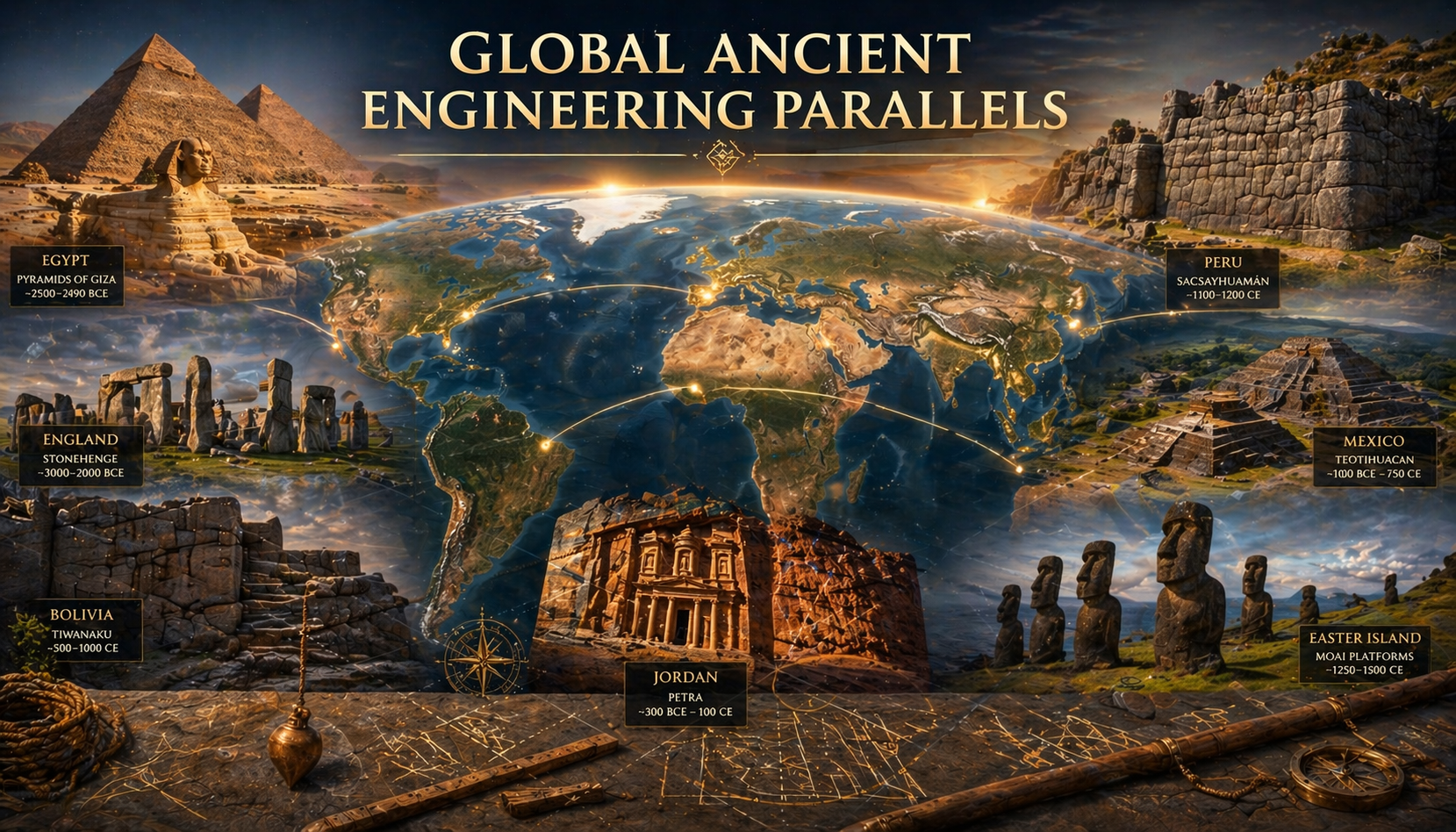
The study of global ancient engineering parallels introduces a compelling perspective on early human development: the possibility that distant civilizations, separated by geography and time, produced remarkably similar construction techniques, design principles, and architectural outcomes. From massive stone structures to precise geometric layouts, these similarities raise an essential question—are these parallels the result of independent innovation, or do they reflect shared knowledge systems that have yet to be fully understood?
Traditional explanations favor independent development, suggesting that different societies, when faced with similar environmental and structural challenges, arrived at comparable solutions. This perspective is supported by the adaptability and ingenuity of human problem-solving. However, the consistency and specificity of certain features across cultures invite a deeper examination, particularly when those features involve precision, scale, and long-term durability (Ancient Construction Similarities: Global Parallels link).
The concept of global ancient engineering parallels does not seek to replace established interpretations, but to expand the framework through which ancient construction is analyzed, encouraging a broader and more integrated view of early technological capability (Lost Ancient Tools link).
Repetition of Form: Structural Similarities
Across multiple continents, ancient structures display recurring forms that suggest a shared approach to construction. These include large stone blocks arranged with tight joints, stepped architectural designs, and the use of massive platforms as foundational elements. Examples often cited include:
- Monumental stone complexes in Egypt and South America
- Polygonal masonry in high-altitude regions
- Large-scale stone alignments in Europe and Asia
While each of these examples exists within its own cultural context, the structural similarities raise questions about how such consistent approaches emerged. The concept of global ancient engineering parallels suggests that these patterns may reflect common principles rather than isolated inventions (Megalith Cutting Precision: Ancient Stone Techniques link).
Precision and Stone Fitting
One of the most striking aspects of ancient construction is the precision with which stones are shaped and fitted together. In multiple regions, stone blocks exhibit tight joints that require minimal or no binding material, relying instead on the accuracy of the fit itself. This level of precision implies:
- Controlled shaping processes
- Reliable measurement systems
- Consistent application of technique
The recurrence of such features across different cultures strengthens the case for global ancient engineering parallels, as it suggests that similar solutions were developed for achieving structural stability and longevity (Ancient Energy Systems Myth or Technology link).
Geometry and Spatial Organization
Geometry plays a central role in the discussion of global ancient engineering parallels, particularly in the way structures are organized and aligned. Across various sites, there is evidence of:
- Symmetrical layouts
- Proportional relationships
- Alignment with cardinal directions
These elements indicate that ancient builders were not only constructing physically stable structures, but also organizing space according to consistent rules. Whether these rules were derived independently or shared through some form of transmission remains an open question.
What is clear is that geometry provided a universal language for construction, allowing complex ideas to be translated into physical form with clarity and precision (Prehistoric Construction Systems Engineering link).
Integration with the Natural Environment
Ancient structures often demonstrate a deep integration with their surrounding environment, incorporating natural features such as terrain, water sources, and solar orientation. This integration is evident in:
- Structures aligned with the horizon
- Sites positioned to interact with natural light cycles
- Construction that adapts to geological conditions
These practices suggest that ancient builders were not working against their environment, but with it, using natural conditions as part of the construction process. The recurrence of such approaches across cultures reinforces the concept of global ancient engineering parallels, highlighting a shared understanding of environmental interaction (Prehistoric Construction Systems Engineering Before Civilizations link).
Material Selection and Consistency
The choice and use of materials also reveal patterns that support the idea of global ancient engineering parallels. Across different regions, builders selected materials based on durability, workability, and availability, often demonstrating a deep understanding of how those materials would perform over time. In many cases:
- Hard stones were used for structural elements
- Softer materials were used for finishing or internal features
- Material combinations were applied strategically
This level of consistency suggests that material knowledge was not only practical, but systematic, contributing to the long-term stability of structures (Ancient Construction Project Management: Systems Before Theory link).
Independent Innovation or Shared Knowledge
The central debate within global ancient engineering parallels revolves around whether these similarities are the result of independent innovation or some form of shared knowledge. Mainstream archaeology supports the idea of independent development, emphasizing the capacity of human societies to solve similar problems in similar ways.
However, the presence of highly specific similarities—particularly in precision techniques and structural organization—has led some researchers to consider the possibility of knowledge exchange or common origins. While there is no definitive evidence for large-scale global transmission systems, the consistency of certain features suggests that the question remains open.
A balanced perspective recognizes that both independent innovation and limited forms of knowledge transfer may have played a role.
Insights from Independent Research
Independent researchers have explored the concept of global ancient engineering parallels from alternative perspectives, examining whether certain patterns may indicate deeper connections between ancient societies. Investigations associated with The Land of Chem consider how shared principles of construction, geometry, and environmental interaction might reflect broader systems of knowledge.
While these ideas require careful evaluation, they contribute to a wider discussion that encourages continued exploration and interdisciplinary analysis.
The Role of Knowledge Systems
At the core of global ancient engineering parallels is the idea that construction is not only a physical activity, but a knowledge system. This system includes:
- Techniques for shaping and assembling materials
- Methods for measuring and aligning structures
- Processes for organizing labor and workflow
When similar knowledge systems appear across different regions, it suggests that certain principles may be universal, arising naturally from the interaction between human capability and environmental constraints.
Modern Analysis and Comparative Studies
Modern research methods are allowing for more detailed comparisons between ancient sites, using tools such as digital modeling and statistical analysis. These approaches enable researchers to:
- Identify patterns across different regions
- Compare dimensions and proportions
- Analyze structural similarities
Such studies provide a more objective basis for evaluating global ancient engineering parallels, moving beyond observation toward measurable comparison.
Conclusion: A Shared Language of Construction
The concept of global ancient engineering parallels highlights the possibility that ancient civilizations, despite their differences, operated within a shared framework of principles that guided construction. Whether these principles emerged independently or were influenced by some form of connection, their consistency suggests a level of sophistication that extends beyond isolated achievements.
By examining these parallels through a balanced and evidence-based approach, it becomes possible to appreciate the depth of ancient engineering without relying on unsupported conclusions. The result is a more comprehensive understanding of how early societies shaped their world, revealing patterns that continue to inform modern perspectives on technology and design.
References and Further Reading
The Land of Chem — Independent perspectives on ancient systems (link)
John A. Burke and Andrija Puharich — Seed of Knowledge, Stone of Plenty(link)
John A. Burke — Experimental research on megalithic sites
ResearchGate — Academic studies on ancient engineering and materials
Encyclopaedia Britannica — Ancient Engineering and Architecture
JSTOR — Archaeological and Engineering Studies
JSTOR — Cross-Cultural Archaeological Studies
JSTOR — Archaeological Studies on Stoneworking Techniques (link)
Ancient Maps and Star Charts — Lost Knowledge Traditions (link)
Ancient Construction Materials — Lost Techniques (link)
ResearchGate — Studies on ancient engineering and environmental systems (link)
Encyclopaedia Britannica — Measurement and Ancient Engineering (link)
Pyramids Not Tombs: What Were They? (part1)
Pyramids Not Tombs: What Were They? (part2)
Pyramids Not Tombs: What Were They? (part3)
Giza Power — Engineering analysis of the Great Pyramid (link)