Beyond Building: The Hidden Discipline
The question of how ancient structures were built is often framed in terms of tools, materials, and techniques. Yet this perspective, while essential, overlooks a critical dimension: organization. The scale, precision, and coordination required to construct megalithic sites suggest that ancient societies were not only capable builders, but also effective managers of complex projects. This is where the concept of ancient construction project management becomes essential (Ancient Construction Project Management: Systems Before Theory link).
Massive stone structures, aligned with precision and assembled with consistency, do not emerge from isolated effort. They require planning, sequencing, resource allocation, and oversight. These elements form the foundation of what is now recognized as project management, even if ancient builders did not formalize it in written methodologies. The absence of documentation does not imply the absence of structure; rather, it invites a reconstruction of how such systems may have operated in practice (Ancient Construction Systems Engineering link).
Understanding ancient construction project management provides a new lens through which to interpret ancient achievements, shifting the focus from individual techniques to the orchestration of entire systems (Ancient Measurement Systems link).
Planning Before Construction — Concept to Execution
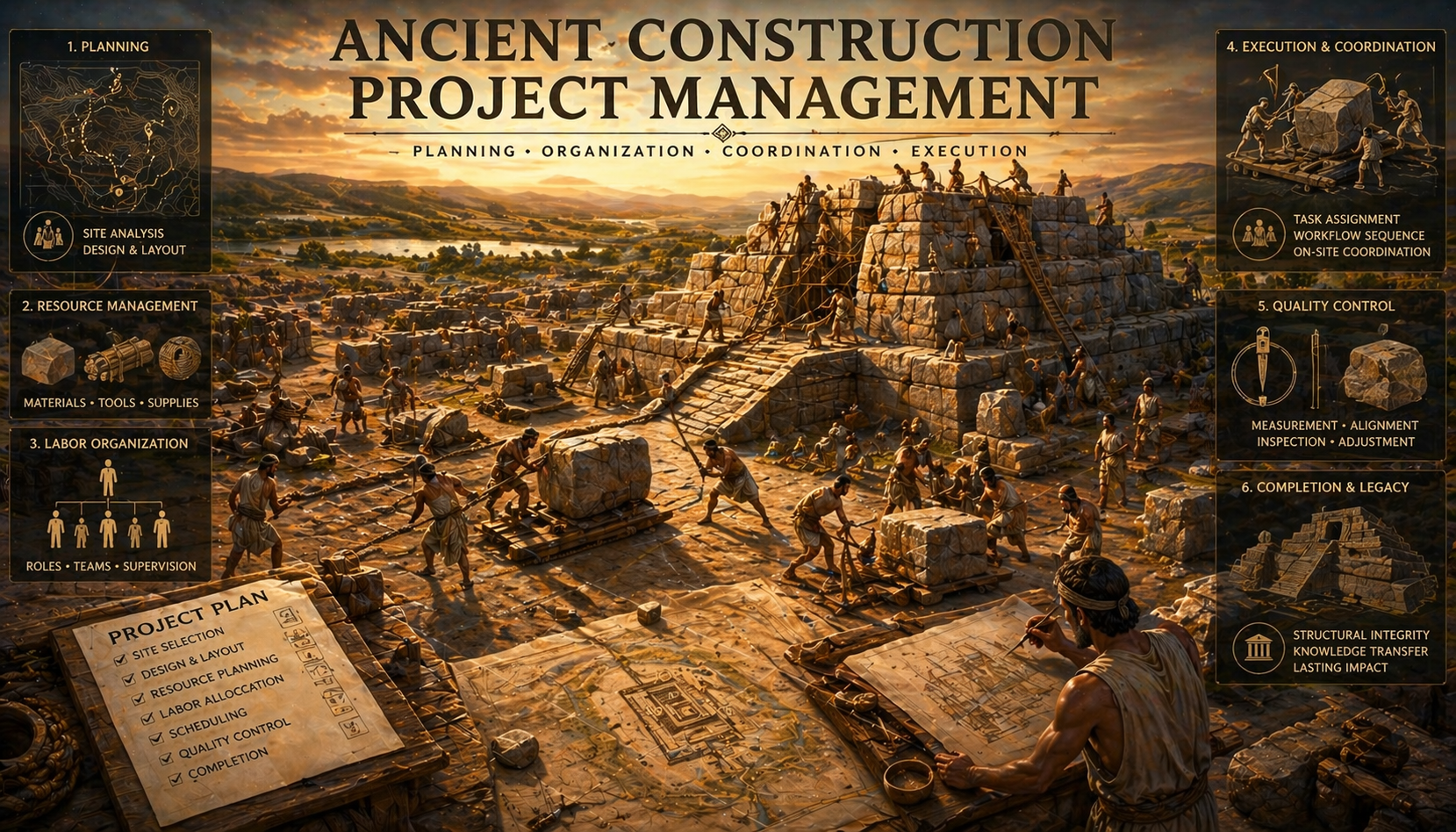
Every large-scale construction project begins with planning, and ancient structures are no exception. Before the first stone was moved, decisions had to be made regarding location, orientation, scale, and sequence. These decisions required an understanding of terrain, material availability, and environmental conditions. Planning likely involved:
- Site selection based on stability and access
- Orientation aligned with environmental or geometric principles
- Estimation of materials and labor requirements
Such considerations indicate that ancient construction project management included a conceptual phase, where ideas were translated into actionable plans. This phase would have defined the scope of the project, setting the framework for all subsequent activity (Lost Ancient Tools link).
Labor Organization: Coordinating Human Effort
The construction of megalithic structures required the coordinated effort of large groups of people. Managing this workforce would have been a central component of ancient construction project management, ensuring that tasks were distributed effectively and executed in the correct sequence. Labor organization may have included:
- Division of roles based on skill
- Teams assigned to specific tasks
- Supervision to maintain quality and consistency
This level of coordination suggests a structured hierarchy, where knowledge and responsibility were distributed across different levels. Skilled individuals likely guided less experienced workers, ensuring that techniques were applied consistently throughout the project (Ancient Stone Cutting Precision and Techniques link).
Logistics and Resource Management
Transporting and positioning massive stones requires careful logistical planning. Materials had to be sourced, moved, and prepared in a sequence that aligned with construction stages. Delays or inefficiencies in one area could affect the entire project. Key logistical considerations include:
- Quarrying and material extraction
- Transportation routes and methods
- Timing of delivery relative to construction phases
These elements highlight the complexity of ancient construction project management, where coordination extended beyond the construction site to include supply chains and resource flow (Ancient Engineering Tolerance link).
Sequencing and Workflow Control
Large construction projects must follow a defined sequence to ensure structural integrity and efficiency. Ancient builders appear to have understood this principle, organizing their work in stages that allowed for gradual assembly and refinement. Sequencing may have involved:
- Preparing foundations before vertical construction
- Shaping stones prior to placement
- Aligning structures progressively rather than all at once
This approach reduces errors and allows for continuous verification, ensuring that each stage supports the next. In modern terms, this reflects workflow control, a key component of project management (Ancient Energy Systems: Myth or Technology link).
Measurement Integration: Ensuring Accuracy
Measurement systems were not separate from construction; they were integrated into every stage of the process. Ensuring alignment, proportion, and consistency required continuous verification, making measurement a core element of ancient construction project management. This integration likely involved:
- Repeated checks during placement
- Use of reference points and lines
- Adjustment of elements before final fixing and installation
The result is a system where precision is maintained not through a single action, but through continuous monitoring and correction (Aligning Earth and Sky link).
Quality Control: Maintaining Standards
Consistency across large structures suggests that ancient builders implemented forms of quality control. Deviations in shape, alignment, or fit would have been identified and corrected during construction, preventing cumulative errors. Quality control may have included:
- Inspection of individual components
- Verification of alignment during assembly
- Correction of inconsistencies before progression
These practices indicate that ancient construction project management involved not only execution, but evaluation, ensuring that standards were maintained throughout the project.
Time Management and Project Duration
The construction of large structures often spans extended periods, requiring sustained coordination and resource management. Time management, while not formally documented, would have been an implicit part of ancient construction project management. This includes:
- Scheduling stages of work
- Coordinating labor availability
- Managing seasonal or environmental constraints
Such considerations ensure that projects progress efficiently, even in the absence of modern scheduling tools.
Knowledge Transfer and Continuity
Projects of significant scale often extend beyond a single generation, making knowledge transfer essential. Techniques, measurements, and processes must be communicated clearly to maintain consistency over time. This suggests that:
- Knowledge was transmitted through instruction and practice
- Standards were maintained across different teams
- Continuity was preserved despite changes in personnel
The ability to sustain complex projects over time reflects a stable system of ancient construction project management, where knowledge was embedded in practice (Ancient Megalithic Engineering link).
Independent Perspectives and Broader Interpretations
Some independent researchers have explored whether ancient construction project management included additional layers of coordination, possibly integrating environmental or geometric principles in ways not fully captured by conventional models. Investigations associated with The Land of Chem consider how construction processes may have interacted with natural systems beyond purely structural concerns.
While these perspectives remain exploratory, they encourage a broader examination of how ancient projects were conceived and executed (Ancient Construction Similarities link).
Modern Comparison: Continuity of Principles
When compared with modern project management, many principles appear consistent:
- Planning defines scope
- Organization distributes tasks
- Measurement ensures accuracy
- Quality control maintains standards
The primary difference lies in the tools used to implement these principles. Ancient builders relied on direct observation and experience, while modern systems incorporate digital tools and formal methodologies. Despite this difference, the underlying logic remains the same.
This continuity suggests that ancient construction project management represents an early form of structured thinking that continues to shape engineering practices today (Did Ancients Inherit Science? link).
Conclusion: The Architecture of Organization
The construction of ancient structures was not only a technical achievement, but an organizational one. The ability to coordinate labor, manage resources, and maintain precision across large-scale projects reflects a level of sophistication that extends beyond tools and materials.
By examining ancient construction project management, it becomes possible to understand how these achievements were made possible—not as isolated acts of craftsmanship, but as the result of integrated systems that combined planning, execution, and control. This perspective not only enriches the study of ancient engineering, but also highlights the enduring relevance of these principles in modern practice (Serapeum Burial Narrative Collapse link).
References and Further Reading
The Land of Chem — Independent perspectives on ancient systems (link)
John A. Burke and Andrija Puharich — Seed of Knowledge, Stone of Plenty (link)
ResearchGate — Studies on ancient engineering and organization
Encyclopaedia Britannica — Construction and Engineering History
JSTOR — Archaeological Studies on Stoneworking Techniques (link)
Pyramids Not Tombs: What Were They? (part1)
Pyramids Not Tombs: What Were They? (part2)
Pyramids Not Tombs: What Were They? (part3)
Giza Power — Engineering analysis of the Great Pyramid (link)