The Cart Ruts of Syracuse: Tracks of Forgotten Civilizations
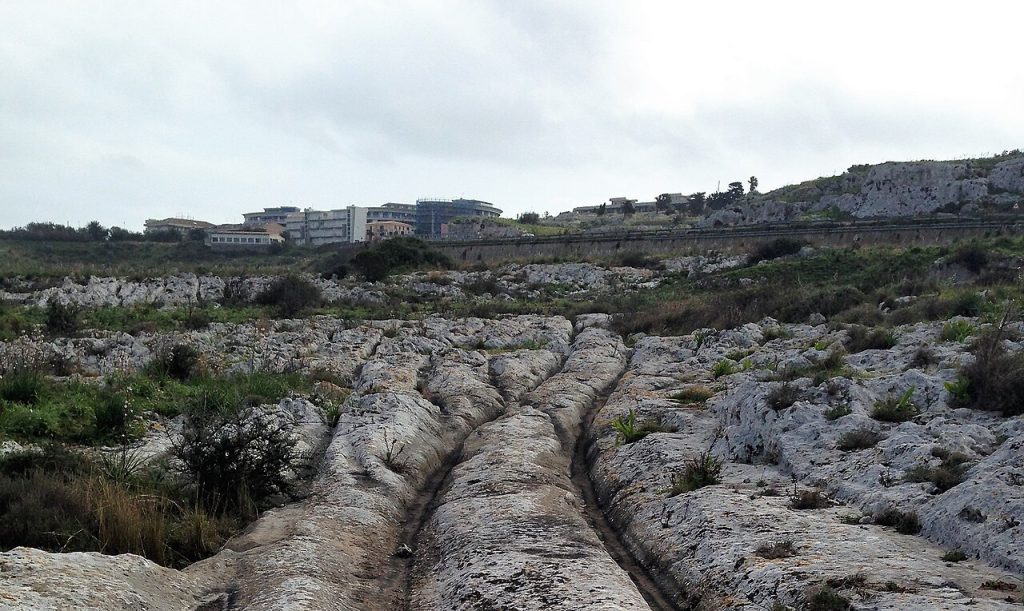
Across the rugged limestone of Syracuse, Sicily, ancient grooves cut into the bedrock tell a story that remains unsolved. Known as cart ruts, these parallel channels run across fields, descend slopes, and even vanish into the sea. To casual visitors, they resemble the scars left by centuries of wagon traffic. But a closer look—both in Sicily and around the world—reveals something far more puzzling.
Were these truly the work of Greek colonists or Roman settlers? Or do they connect Syracuse to a far older, global tradition that spans continents and millennia?
A Sicilian Enigma
The cart ruts of Syracuse, sometimes called carraie greche or “Greek cart tracks,” appear most prominently around Contrada Targia. They also stretch toward Augusta, Vendicari, and Eloro (Noto), and similar examples are documented in the Valley of the Temples at Agrigento and western Sicily near Marsala.
What makes them distinctive is their form: two parallel grooves, typically about 1.2–1.4 meters apart, carved into solid limestone. Some are shallow, others cut more than half a meter deep, as though repeatedly worn by wheels or dragged loads. But their irregularity, sudden direction changes, and occasional intersections suggest more than simple wagon tracks.
Theories of Origin
Archaeologists and independent researchers have proposed a range of explanations, but none fits neatly.
-
Megalithic Transport: Some link the ruts to Malta’s extensive networks, proposing that ancient Sicilians carved them thousands of years ago to move massive stone blocks. Yet Syracuse lacks the monumental temples of Malta, and most local ruts are dated much later.
-
Greek or Phoenician Engineering: Others believe colonists arriving in the 8th–7th century BC created the tracks as early roads. Still, their rough design clashes with the Greeks’ reputation for precise urban planning.
-
Roman Infrastructure: After Rome conquered Syracuse in 212 BC, could the ruts have served as Roman byways? This seems doubtful. The Romans mastered the art of paved roads; why would they rely on crude stone grooves in such a strategic city?
-
Indigenous Origins: A compelling alternative is that the tracks predate colonization. Populations like the Sicani or Siculi may have carved them for transport—or for purposes now forgotten. Archaeologist Paolo Orsi himself noted their “systematic but primitive” layout, which did not match classical construction.
Beyond Roads: Rituals, Symbols, or Something Else?
The puzzle deepens when considering alternative interpretations.
Some researchers suggest the ruts were ritual pathways, perhaps leading to necropolises or sanctuaries. Others argue they might be geoglyphs—patterns meant to be seen from above, akin to Peru’s Nazca Lines. Decorative pottery with similar linear motifs has been uncovered nearby, strengthening the symbolic argument.
Another theory casts them as astronomical alignments, possibly marking solar or stellar events. While no firm evidence supports this at Syracuse, similar claims have been made for rut networks in Malta and the Canary Islands.
A Global Mystery
Syracuse is not unique. As Ancient360 documents, cart ruts appear worldwide:
-
In Malta, dense rut networks run across the island, sometimes plunging into the sea.
-
In Sardinia, grooves cut across rocky plains.
-
In Spain and the Canary Islands, unexplained tracks crisscross volcanic stone.
-
In the USA, as Ancient360 notes, ruts appear in Texas, Arizona, and California—astonishingly similar to Mediterranean examples.
The consistency of spacing across these sites suggests standardization, as if ancient builders followed a common design. Could this point to a shared technology—or even contact between far-flung civilizations? Some researchers, as Ancient360 explores, wonder if these tracks are remnants of a lost global culture.
Unanswered Questions
Despite centuries of study, the cart ruts of Syracuse resist easy explanation. Were they carved intentionally or worn gradually by repetitive use? Do they mark functional routes, or encode symbolic and ritual meaning? Are they the heritage of Greeks and Romans—or traces of a civilization lost to time?
What’s certain is that they align Syracuse with a wider archaeological enigma. Each groove in the limestone is more than a scar of movement—it is a signature of forgotten ingenuity, a reminder that history may conceal as much as it reveals.
Conclusion
The cart ruts of Syracuse blur the line between practicality and mystery. Whether roads, rituals, or relics of a vanished world, they connect Sicily to a vast network of stone-carved tracks scattered across the globe.
As Ancient360 emphasizes, solving this puzzle requires crossing the boundaries of archaeology, geology, and mythology. Until then, the grooves carved into Syracuse’s stone remain open questions—silent witnesses to journeys and intentions we can only imagine.