Barabar Caves Construction: Tools, Processes, and Feasibility
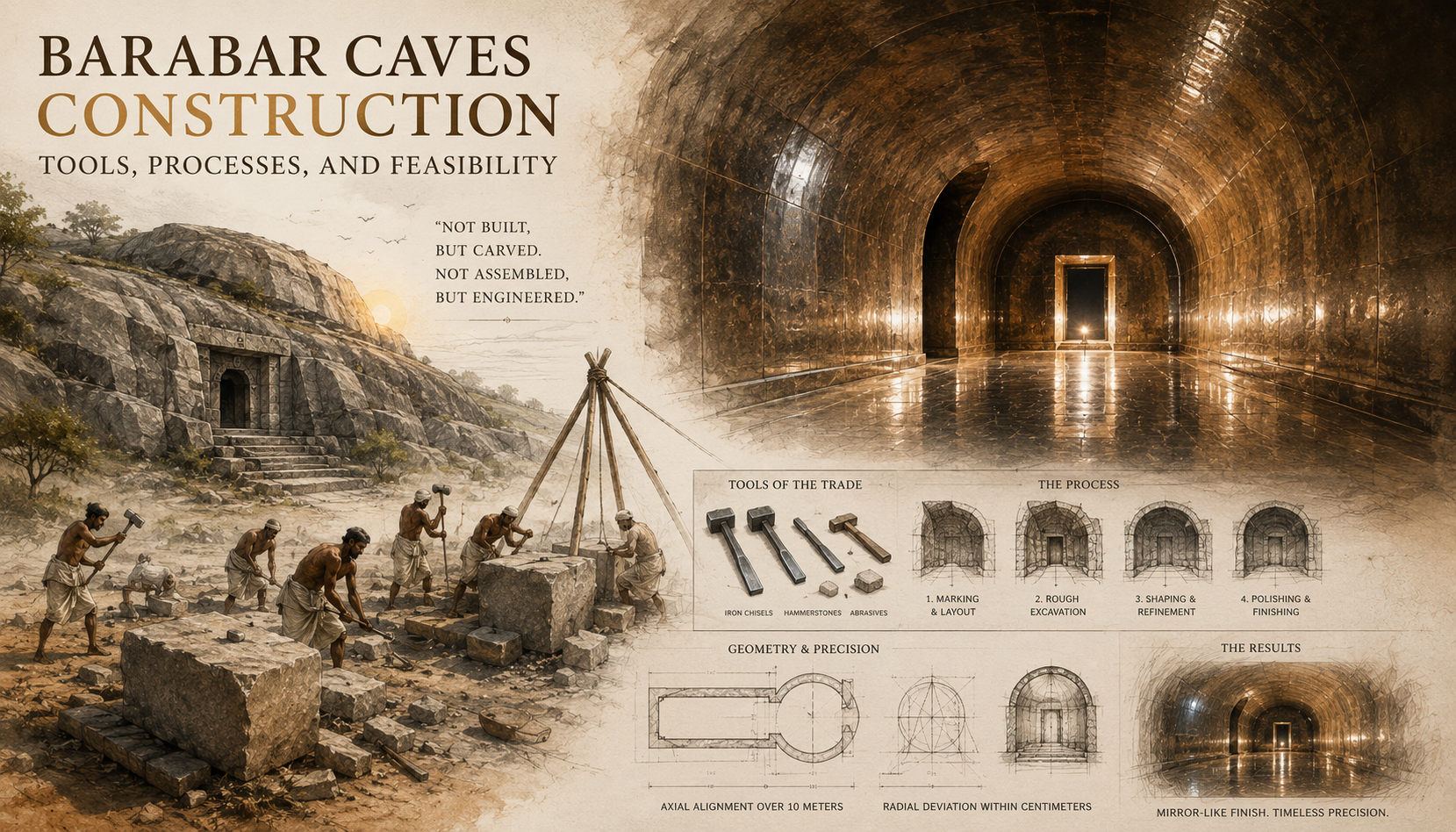
Barabar Caves Construction represents one of the most technically revealing aspects of these extraordinary structures, where the visible outcome forces a deeper examination of process, labor, and feasibility. The Barabar Caves Construction, preserved within the granite hills of Bihar, is traditionally attributed to the Mauryan period under the reign of Ashoka during the third century BCE. Inscriptions found within several chambers support this historical framework and provide valuable insight into the communities that used these spaces. Yet while these inscriptions clarify patronage and occupation, they remain largely silent on the methods of construction themselves. When the caves are analyzed not as cultural artifacts but as engineered systems, the precision of their geometry, the uniformity of their surfaces, and the scale of material removal raise fundamental questions about how such results were achieved within the technological context of the time.
Material Constraints and the Challenge of Granite
Any serious evaluation of Barabar Caves Construction must begin with the material itself. Granite is not a forgiving medium; it is dense, crystalline, and highly resistant to both cutting and abrasion. Composed primarily of quartz and feldspar, it ranks between 6 and 7 on the Mohs hardness scale, making it significantly more difficult to work than the sedimentary stones used in many other ancient structures. This means that every stage of construction—from initial excavation to final polishing—would have required sustained effort, controlled force, and a deep understanding of how the material responds under stress. Unlike softer stone, granite does not allow for rapid shaping or easy correction. Each strike removes material permanently, and each surface refinement demands progressively finer abrasion over extended periods. The decision to carve entire chambers into such a material, rather than a more workable alternative, immediately suggests either necessity or intent—both of which imply a level of planning that extends beyond improvisation.
Tools, Techniques, and the Limits of Iron
The conventional explanation for Barabar Caves Construction centers on the use of iron tools, which were indeed available and widely used in ancient India during the Mauryan period. Iron chisels, hammerstones, and abrasive materials such as quartz sand are generally considered sufficient to account for the carving process. This framework is technically plausible, as iron is capable of shaping granite through repeated striking and abrasion. However, plausibility does not automatically resolve the question of efficiency or precision. Iron tools degrade rapidly when used against hard stone, requiring constant sharpening and replacement, which introduces variability into the cutting process. Maintaining consistent curvature, symmetry, and surface uniformity under these conditions would require not only skilled craftsmanship but also highly disciplined workflows and continuous verification. The tools themselves may be understood, but the system within which they were used—how labor was organized, how measurements were maintained, and how errors were corrected—remains less clearly defined.
Scale of Excavation and Time Implications
The scale of Barabar Caves Construction becomes more apparent when the volume of material removed is considered. The Sudama Cave alone required the excavation of approximately 350 to 400 cubic meters of granite, corresponding to nearly 1,000 tonnes of material. Experimental archaeology suggests that manual granite removal progresses at a relatively slow rate, often measured in fractions of a cubic meter per worker per day. When these rates are applied to the Barabar context, even a coordinated workforce would require several years of continuous labor to complete a single chamber, and this estimate does not include the additional time needed for geometric refinement or polishing. The implication is that these caves were not short-term projects but long-duration undertakings, requiring sustained resource allocation, logistical planning, and administrative oversight. Such commitment aligns with the capabilities of a large imperial system, yet it also emphasizes that the construction process was as significant as the final structure itself.
Sequential Construction and Process Discipline
The internal consistency observed in the Barabar Caves suggests that construction followed a structured sequence rather than an opportunistic approach. The initial phase likely involved establishing a clear layout, including the central axis, chamber proportions, and entrance alignment. This would have been followed by rough excavation, during which the bulk of the granite was removed while leaving margins for later refinement. The subsequent phase required precise geometric correction, ensuring that curvature, symmetry, and alignment were maintained within narrow tolerances. Only after these stages could surface preparation begin, gradually removing tool marks and irregularities before transitioning into the final polishing phase. Each stage depended on the accuracy of the previous one, meaning that errors introduced early in the process would propagate and become increasingly difficult to correct. The absence of such accumulated errors in the finished caves suggests that control mechanisms were in place throughout construction, allowing builders to maintain consistency over extended periods.
Precision, Tolerances, and Control Mechanisms
One of the most striking aspects of Barabar Caves Construction is the level of precision achieved despite the inherent difficulties of the material and environment. Axial alignment appears to be maintained within a few centimeters across lengths approaching ten meters, while circular chambers display radial consistency with minimal deviation. Surface flatness, particularly after polishing, falls within tolerances that would be considered highly controlled even in modern stonework. Achieving such results without advanced measuring instruments implies the use of systematic techniques, possibly including measuring cords, fixed reference points, and repeated verification cycles. Precision in this context is not a byproduct of craftsmanship alone; it is the outcome of a process designed to minimize error at every stage. The caves therefore reflect not only manual skill but also an underlying methodology capable of sustaining accuracy across complex geometries.
Polishing as a Defining Phase of Construction
While excavation establishes the form of the caves, polishing defines their character. The mirror-like finish observed across the granite surfaces is not merely aesthetic but indicative of an extensive and highly controlled process. Polishing granite to such a degree requires multiple stages of abrasion, each using progressively finer materials to reduce surface irregularities to the point where light can reflect uniformly. This process is time-intensive and sensitive to variation, as uneven pressure or inconsistent material would produce visible distortions. In the context of Barabar Caves Construction, polishing likely represented one of the most demanding phases, both in terms of labor and technical execution. Its success depends on the accuracy of all preceding stages, reinforcing the idea that the entire construction process was integrated rather than segmented.
Feasibility and the Question of Efficiency
The conventional explanation of Barabar Caves Construction—iron tools, manual labor, and extended timeframes—remains broadly feasible, yet it leaves open questions regarding efficiency and optimization. If the methods used were purely manual and incremental, the level of consistency achieved becomes increasingly difficult to explain without assuming highly refined techniques and disciplined execution. This does not require the introduction of unknown technologies, but it does suggest that ancient builders may have developed methods that were both effective and systematic, even if they are not fully documented today. Historical precedents show that complex techniques can be lost when the cultural and institutional frameworks that sustain them disappear. In this sense, the Barabar Caves may represent not an anomaly, but a surviving example of a construction tradition that reached a high level of sophistication before gradually fading from collective knowledge.
Conclusion
Barabar Caves Construction stands as a compelling demonstration of what ancient engineering systems were capable of achieving when material understanding, labor organization, and process control were combined effectively. The excavation of vast quantities of granite, the maintenance of precise geometry, and the execution of mirror-like polishing across entire chambers indicate a level of coordination and technical discipline that extends beyond simple explanations. While conventional models provide a plausible foundation, the observable results suggest that these methods were applied with a degree of refinement that is not always fully appreciated. The caves therefore invite a broader perspective, one that recognizes ancient construction not as primitive, but as the product of systems capable of sustained precision over time. In doing so, they continue to challenge assumptions about the limits of early technological capability and the depth of knowledge that may have existed within past civilizations.
References and Further Reading
A History of Ancient and Early Medieval India (link)
The Wonder That Was India (link)
Ancient Indian Architecture More Advanced Thank You Thought (link)
Seed of Knowledge, Stone of Plenty (link)
Academia.edu – Archaeological Survey of India documentation on the Barabar Caves (link)
ResearchGate studies on rock-cut architecture and ancient acoustics (link)
ResearchGate Mirror-Polished Granite Caves -Barabar Hills (link)
Ancient Hyper Forests and Giant Trees (link)
Pre Flood Civilization and Environmental Collapse (link)
Was the Ancient World Phisically Different? (link)
Giant Humans Before the Younger Dryas (link)
Ancient Construction Project Management (link)
Ice Age Civilization Lost Worlds Before Floods (link)
Lost Knowledge of Ice Age Rewritten History (link)
Ice Age Knowledge Science Before Younger Dryas (link)
Geometry and Earth Scaling (link)
How Ancient Builders Measured the Stars (link)