Barabar Caves Origins: Lost Knowledge or Mauryan Mastery
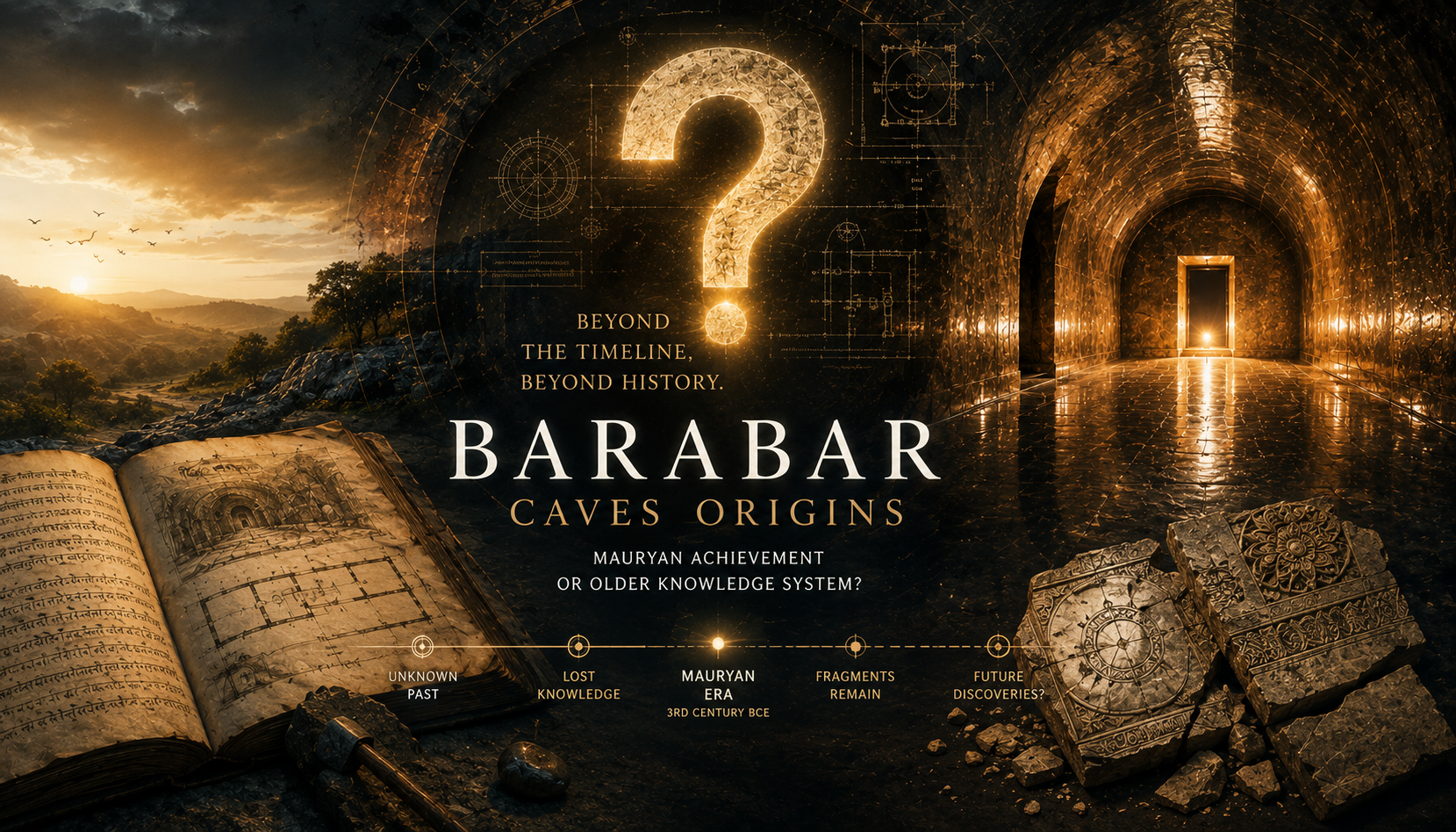
Barabar Caves Origins remain a central question in understanding not only these remarkable structures, but the broader timeline of human technological development. The Barabar Caves Origins, traditionally placed within the Mauryan period in the granite hills of Bihar, are supported by inscriptions linking the caves to the reign of Ashoka and his successor Dasharatha. These inscriptions provide a clear historical anchor, suggesting that the caves were completed and used during the third century BCE. Yet while this dating establishes a moment of occupation and patronage, it does not necessarily define the full story of their conception, development, or underlying technical tradition (Barabar Caves Precision Beyond Explanation – article). When the precision, polishing, and construction complexity are considered together, the Barabar Caves Origins begin to raise a deeper question: do these caves represent a peak achievement of the Mauryan Empire, or do they preserve elements of an older, partially lost knowledge system?
Barabar Caves Origins Within the Mauryan Framework
The conventional interpretation of Barabar Caves Origins situates them firmly within one of the most organized and powerful political systems of the ancient world. The Mauryan Empire, at its height, governed a vast territory and demonstrated advanced capabilities in administration, metallurgy, infrastructure, and monumental construction. Within this context, the caves can be understood as a product of state-sponsored engineering, where resources, labor, and expertise were mobilized to create spaces for philosophical and religious communities such as the Ajivikas.
This explanation is both logical and supported by historical evidence. The inscriptions carved into the caves explicitly dedicate them to the Ajivika sect, reinforcing the idea that these structures were commissioned and completed during this period. Furthermore, other Mauryan artifacts, including polished stone pillars, exhibit a similar level of surface refinement, often referred to as the “Mauryan polish.” These parallels suggest that the techniques required to produce the Barabar interiors were not entirely isolated but part of a broader technological tradition within the empire.
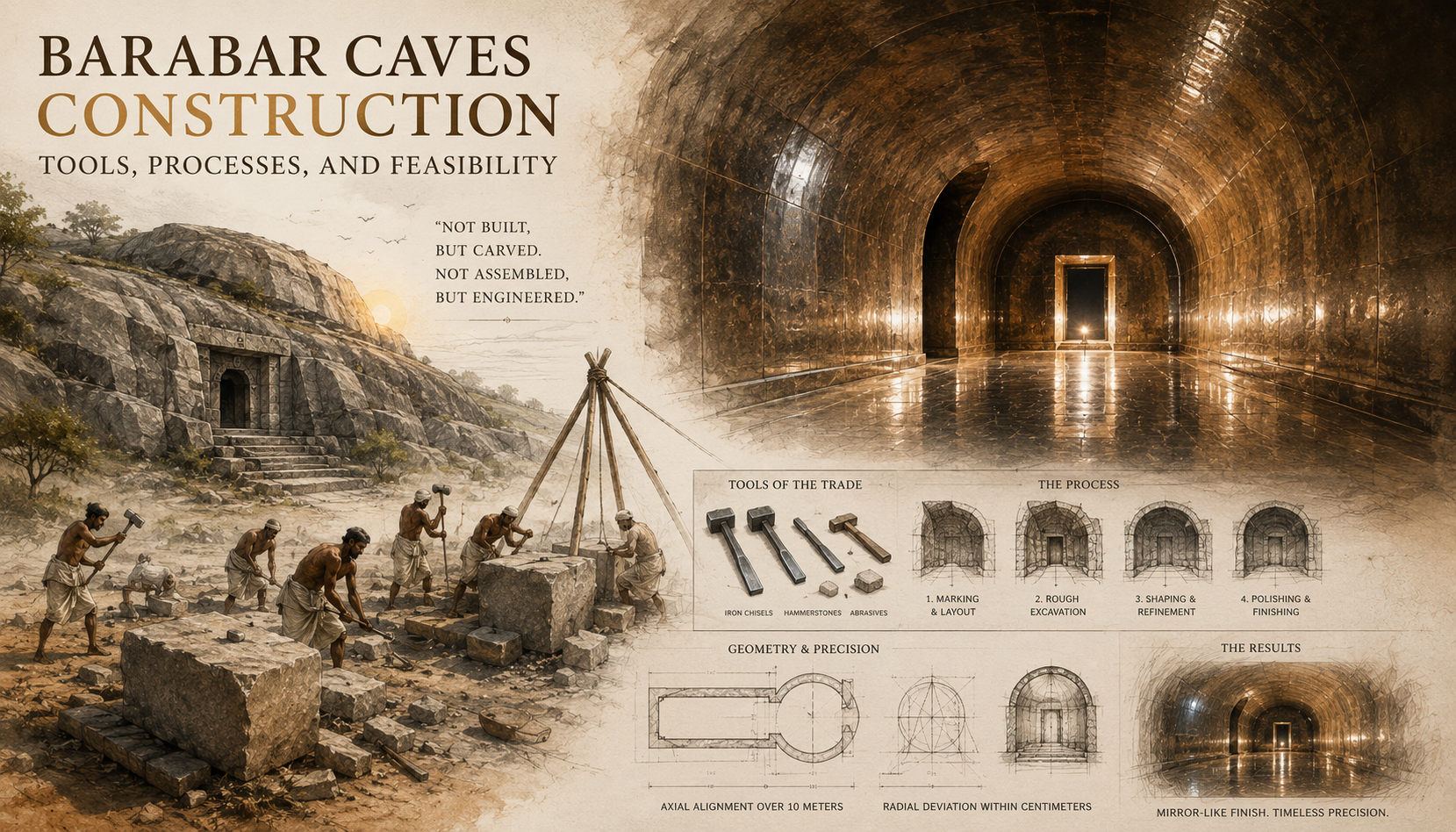
However, while the Mauryan framework explains the existence of the caves, it does not fully resolve the question of development. It identifies who used and possibly commissioned the structures, but it does not necessarily explain how such refined methods emerged so fully developed at this specific moment in time (Barabar Caves Construction: Tools, Processes, Feasability – article).
The Question of Technological Maturity
One of the most intriguing aspects of Barabar Caves Origins is the apparent maturity of the techniques involved. The geometry, symmetry, and polishing do not appear experimental or transitional; instead, they suggest a process already refined through prior experience. In many technological systems, early stages are marked by inconsistency, variation, and gradual improvement. Yet in the Barabar Caves, the execution appears remarkably consistent from the outset (Barabar Caves Measurements – article).
This raises an important line of inquiry. If the caves represent the early phase of Mauryan rock-cut architecture, where are the less refined predecessors that would normally precede such precision? The archaeological record does include other rock-cut sites across India, but few match the combination of mirror-like polishing and geometric consistency observed at Barabar. The absence of a clear developmental sequence does not invalidate the Mauryan attribution, but it introduces the possibility that the techniques used were inherited, adapted, or accelerated rather than developed entirely within this period.
Barabar Caves Origins and Lost Technical Traditions
When viewed within the broader context of human history, the possibility of lost or fragmented knowledge systems becomes increasingly relevant. Modern humans have existed for approximately 300,000 years, while written history covers only a small fraction of that timeline. Across this vast span, climatic shifts, sea-level rise, tectonic activity, and social collapse have repeatedly reshaped human populations and erased material evidence of earlier cultures.
Within this framework, Barabar Caves Origins may reflect the continuation of technical traditions that predate the Mauryan Empire. Such traditions could have been transmitted through apprenticeship, oral knowledge, or regional craftsmanship rather than written documentation. The precision observed in the caves may therefore represent not a sudden innovation, but the culmination of knowledge refined over generations and preserved within specialized groups of artisans.
This perspective does not require the assumption of unknown or speculative technologies. Instead, it suggests that human societies may have achieved high levels of technical proficiency in specific domains, only for those capabilities to diminish or disappear over time as social structures changed. Historical examples such as Roman concrete, Damascus steel, and certain forms of ancient metallurgy demonstrate that complex knowledge can be lost and later only partially reconstructed (Barabar Caves Polishing Mystery – article).
Geological Time, Climate Cycles, and Cultural Continuity
The question of Barabar Caves Origins also intersects with the broader theme of environmental change and its impact on human societies. Over the last 40,000 years, Earth has experienced significant climatic fluctuations, including glacial advances, rapid warming events, and large-scale ecological transitions. These cycles would have influenced migration patterns, resource availability, and the continuity of cultural knowledge.
If early human populations repeatedly adapted to such changes, it becomes plausible that knowledge systems evolved in parallel, sometimes advancing, sometimes fragmenting. Coastal regions—often centers of early settlement—were particularly vulnerable to sea-level rise following the last Ice Age, potentially submerging entire cultural landscapes. In this context, the surviving inland monuments may represent only a fraction of a much larger and more complex historical network.
Barabar Caves Origins, therefore, may not be isolated in time but connected to longer trajectories of human development shaped by both continuity and disruption. The caves could represent a point where knowledge was preserved and expressed in durable form, even as other aspects of the same system were lost (Barabar Caves Symmetry – article).
Mainstream Chronology and Its Boundaries
It is important to recognize that mainstream archaeology operates within a framework defined by available evidence, including inscriptions, stratigraphy, and material analysis. Within this framework, the dating of the Barabar Caves to the Mauryan period is well supported and remains the most reliable conclusion based on current data. However, this framework also has limitations. It tends to emphasize what can be directly observed and documented, while leaving less room for processes that do not leave clear material traces.
The absence of evidence for earlier phases of similar construction does not necessarily confirm their nonexistence. It may reflect preservation bias, limited excavation, or the simple reality that much of human history remains undocumented. As a result, Barabar Caves Origins sit at the intersection of established history and open inquiry, where the available data provides strong anchors but does not close all questions (Barabar Caves Acoustics – article).
Barabar Caves Origins in a Systems Perspective
When the caves are analyzed as part of a broader system, rather than as isolated monuments, their origins appear more complex. The integration of geometry, material processing, acoustic behavior, and spatial design suggests a level of coordination that extends beyond individual craftsmanship. Such integration is typically associated with established knowledge systems, where different domains of expertise interact within a shared framework.
This perspective encourages a shift in interpretation. Instead of asking whether the caves are Mauryan or older, it may be more productive to consider how Mauryan society could have accessed, preserved, or amplified existing knowledge. The empire’s scale and administrative capacity would have allowed it to gather and deploy skilled artisans from different regions, potentially concentrating techniques that had developed over longer periods.
In this sense, Barabar Caves Origins may represent both a culmination and a continuation—a moment where existing knowledge was expressed with exceptional clarity under favorable social and political conditions.
Conclusion
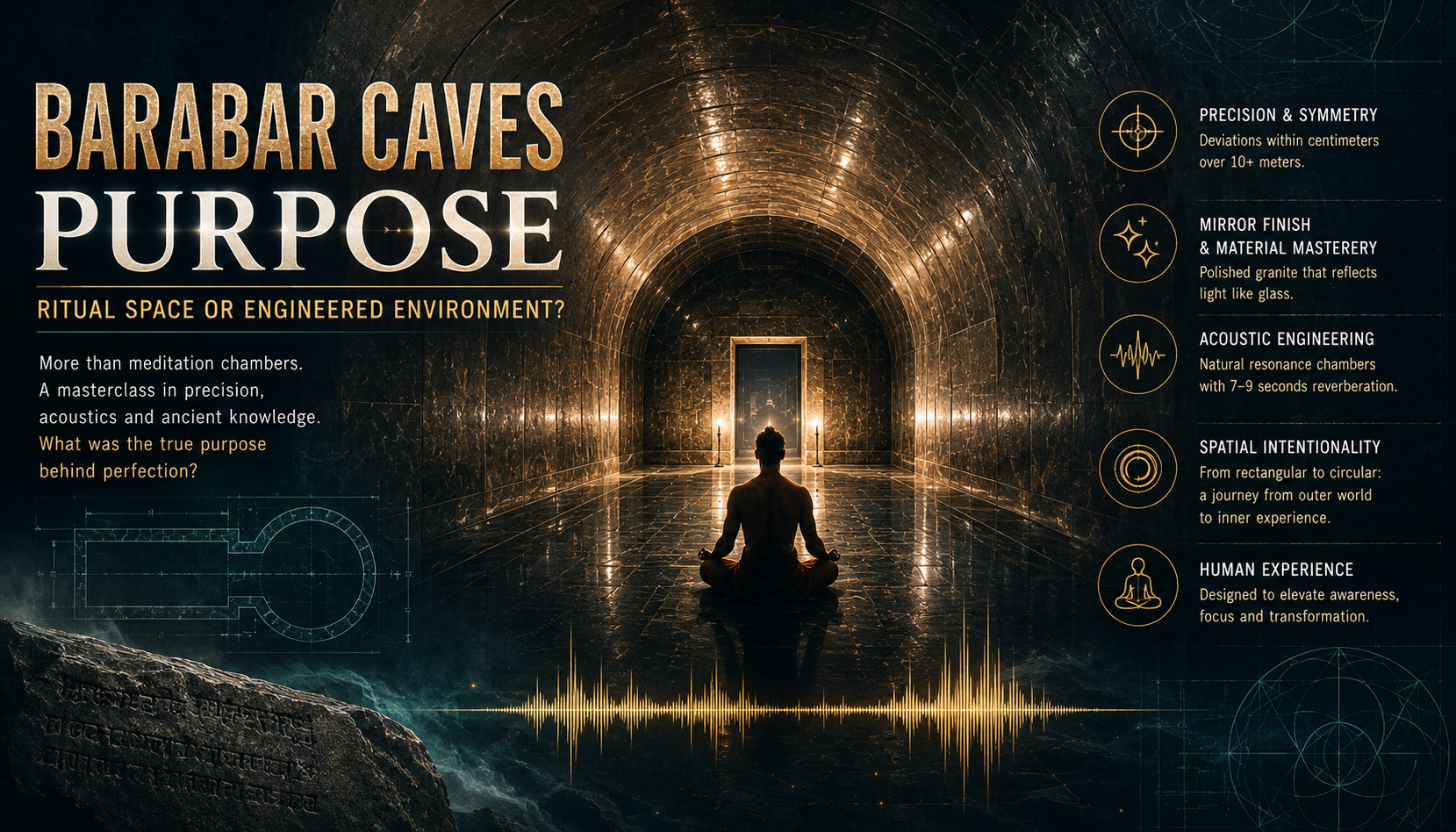
Barabar Caves Origins remain a layered question that resists a single, definitive answer. The Mauryan attribution provides a solid historical foundation, supported by inscriptions and contextual evidence, and should not be dismissed. At the same time, the technical sophistication of the caves—their precision, polishing, and integration of multiple engineering principles—invites consideration of deeper developmental processes that may extend beyond this period. Rather than opposing these perspectives, a more nuanced view recognizes that ancient achievements often emerge from long trajectories of knowledge accumulation, transmission, and occasional loss. The Barabar Caves, in this sense, stand as both products of their time and possible echoes of a broader human story, one in which advanced skills could appear, evolve, and sometimes disappear, leaving behind only fragments for later generations to interpret (Barabar Caves Purpose: Ritual Space or Engineered Environment – article).
References and Further Reading
A History of Ancient and Early Medieval India (link)
The Wonder That Was India (link)
Ancient Indian Architecture More Advanced Thank You Thought (link)
Seed of Knowledge, Stone of Plenty (link)
Academia.edu – Archaeological Survey of India documentation on the Barabar Caves (link)
ResearchGate studies on rock-cut architecture and ancient acoustics (link)
ResearchGate Mirror-Polished Granite Caves -Barabar Hills (link)
Ancient Hyper Forests and Giant Trees (link)
Pre Flood Civilization and Environmental Collapse (link)
Was the Ancient World Phisically Different? (link)
Giant Humans Before the Younger Dryas (link)
Ancient Construction Project Management (link)
Ice Age Civilization Lost Worlds Before Floods (link)
Lost Knowledge of Ice Age Rewritten History (link)
Ice Age Knowledge Science Before Younger Dryas (link)
Geometry and Earth Scaling (link)
How Ancient Builders Measured the Stars (link)