Introduction
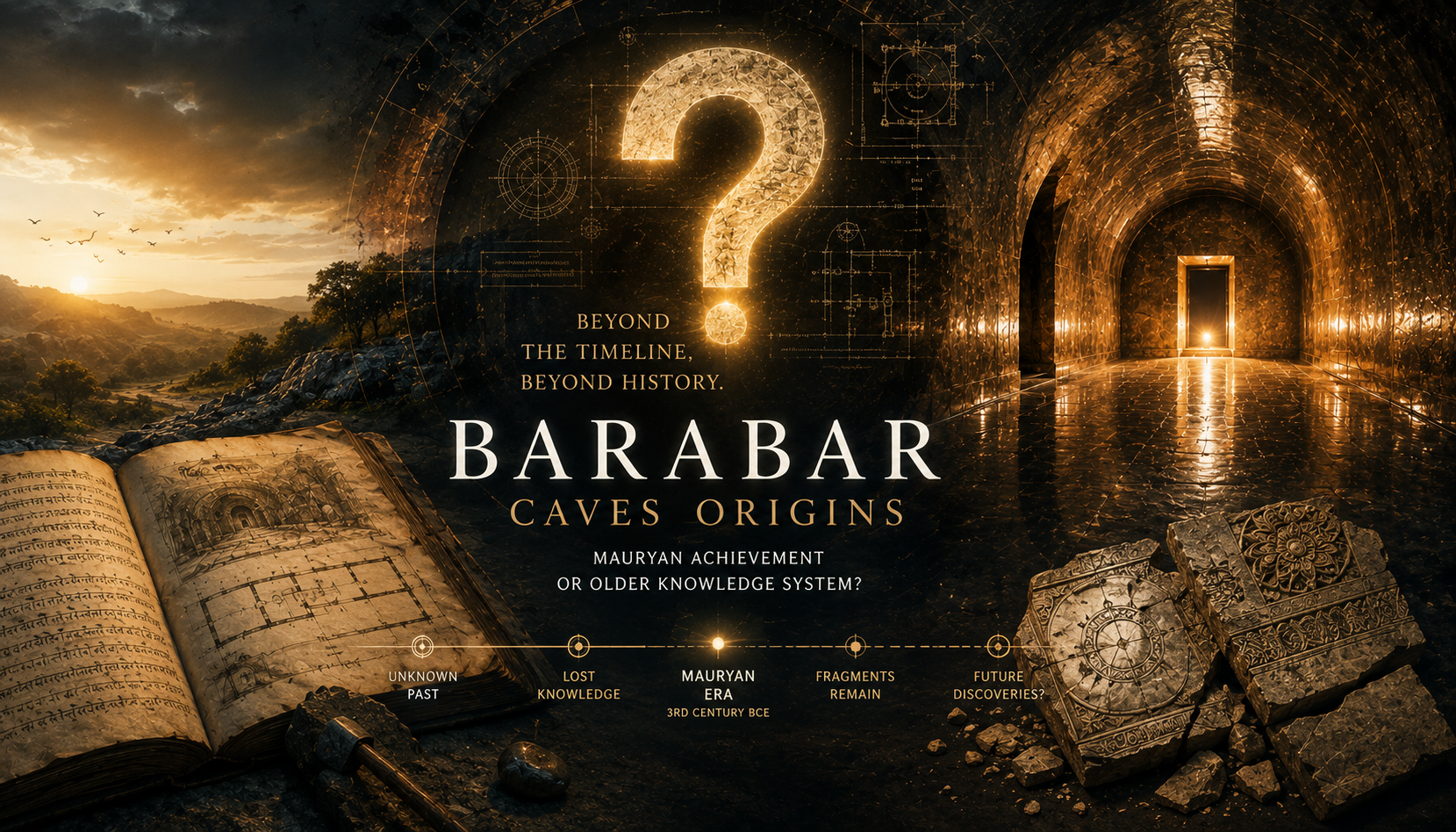
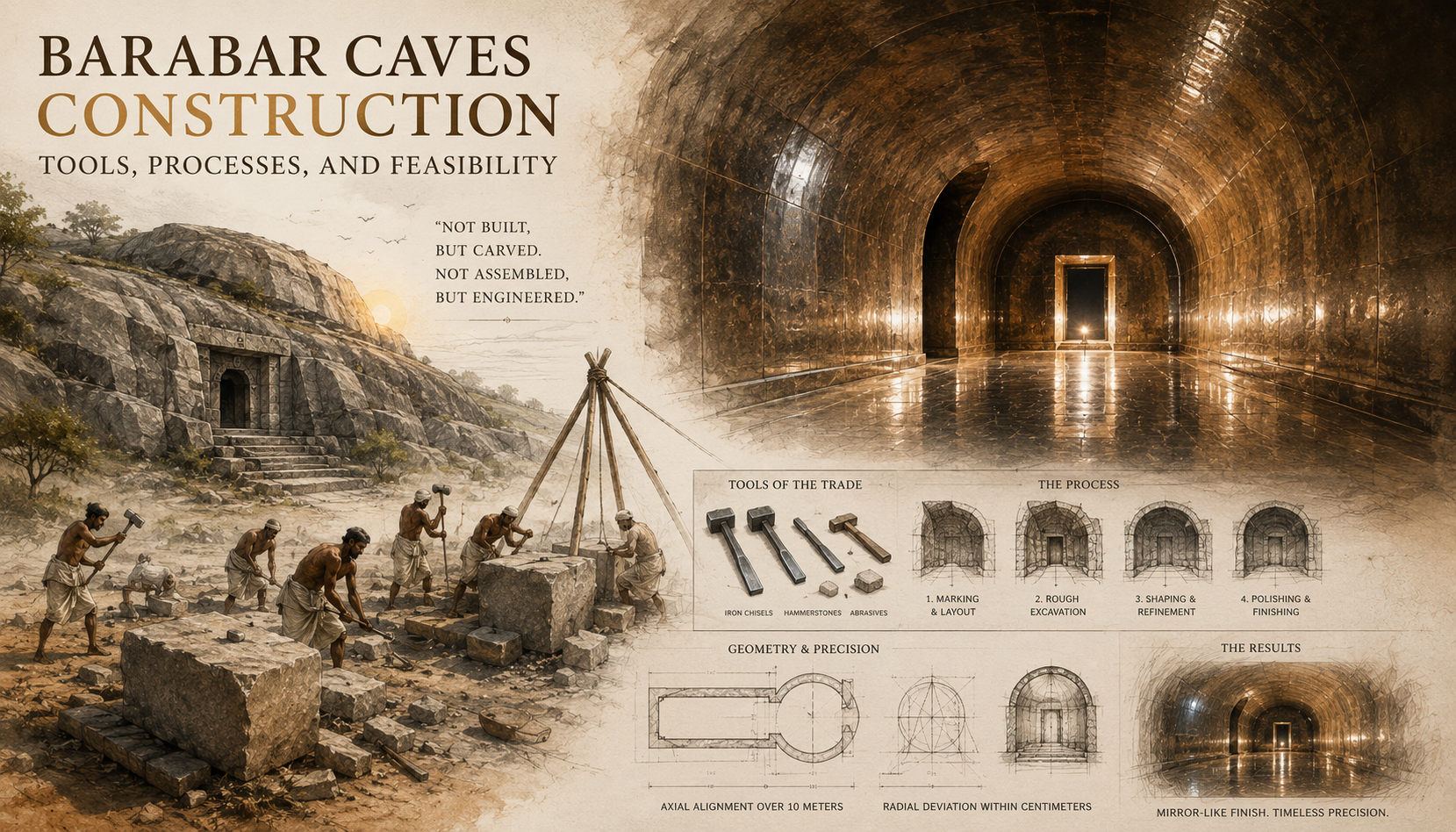
Barabar Caves Legacy represents one of the most compelling unresolved narratives in ancient engineering, where a clear peak of technical achievement is followed by an equally clear decline in comparable execution. The Barabar Caves Legacy, preserved in the granite hills of Bihar, is not defined solely by the existence of the caves themselves, but by what happened after their construction. While these chambers demonstrate extraordinary levels of precision, symmetry, and polishing, later rock-cut structures across the Indian subcontinent rarely replicate the same combination of refinement (Barabar Caves Construction: Tools, Process, Feasability – article). This discontinuity raises a fundamental question: if such techniques were known and mastered, why were they not consistently preserved, expanded, or improved over time?
Barabar Caves Legacy and Architectural Influence
The Barabar Caves Legacy can be partially traced through the evolution of rock-cut architecture in India, where later sites such as the caves of Ajanta and Ellora display increasing complexity in scale, ornamentation, and narrative detail. These later developments suggest that the concept of carving architecture directly into rock continued to evolve, becoming a defining feature of Indian monumental design. However, while these sites demonstrate artistic and structural sophistication, they do not consistently reproduce the mirror-like granite polishing or the same level of geometric precision observed at Barabar.
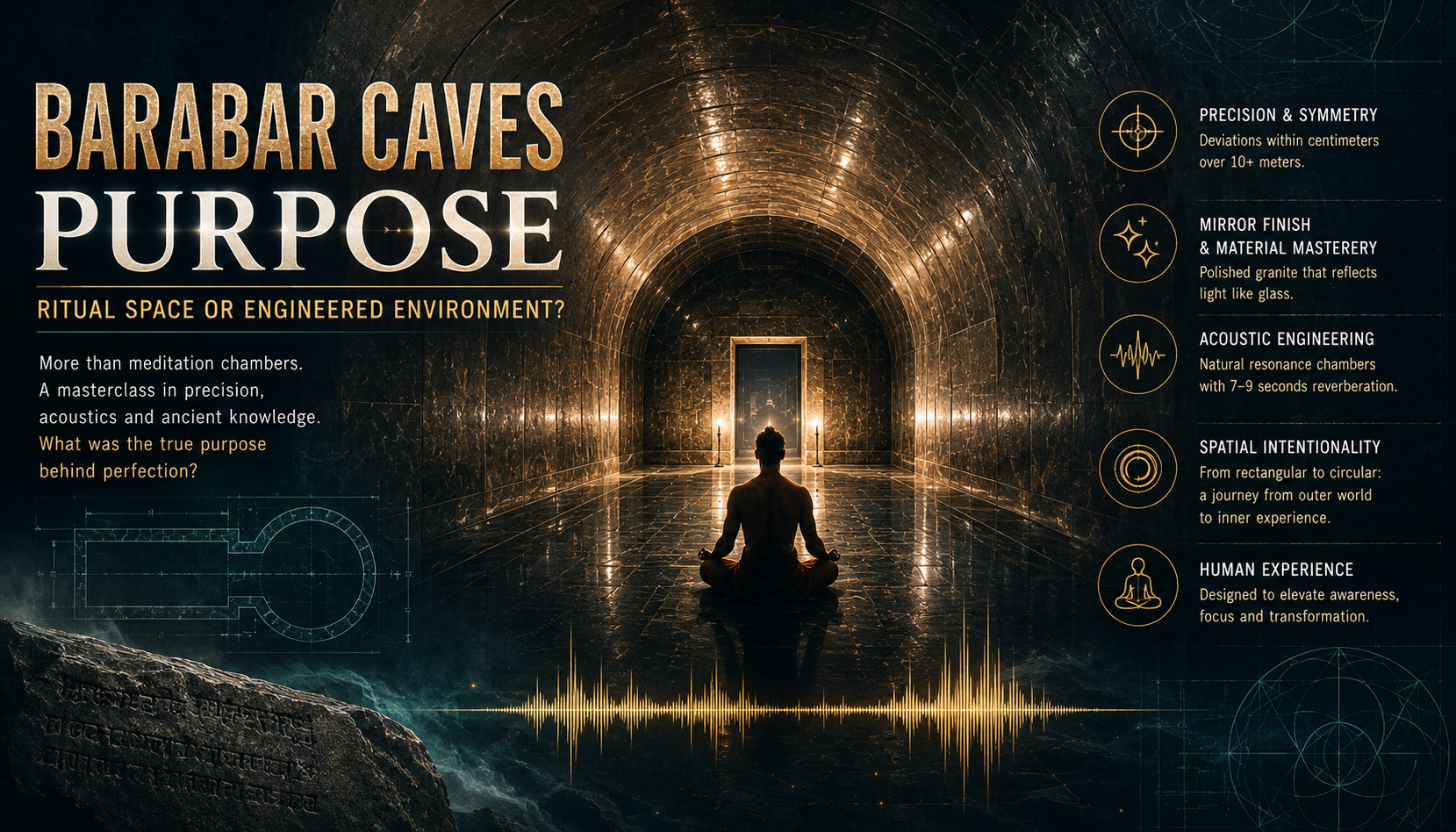
This contrast is subtle but significant. It indicates that while the idea of rock-cut architecture was transmitted and expanded, certain technical aspects of Barabar Caves Legacy—particularly surface finishing and acoustic responsiveness—may not have been fully carried forward. The reasons for this divergence remain unclear. It may reflect changing aesthetic priorities, differences in available materials, or shifts in construction methods. Alternatively, it may suggest that specific techniques used at Barabar were highly specialized and not easily transferable across regions or generations (Barabar Caves Purpose: Ritual Space or Engineered Environment? – article).
The Disappearance of Extreme Precision
One of the most striking elements of Barabar Caves Legacy is the apparent disappearance of its most defining features. The mirror-like polish of the granite interiors, often described as comparable to glass, becomes increasingly rare in later constructions. Similarly, the strict geometric consistency and controlled acoustics observed in the Barabar chambers are not systematically replicated in subsequent sites.
This pattern raises an important possibility: that certain techniques were lost, simplified, or abandoned over time. Historical precedent supports this idea. Complex knowledge systems often depend on stable social structures, skilled labor networks, and sustained institutional support. When these conditions change—due to political fragmentation, economic shifts, or environmental stress—technical knowledge can degrade or disappear. The Barabar Caves Legacy may therefore reflect a moment where a highly refined method reached its peak before gradually fading from practice.
At the same time, it is important to avoid assuming total loss without evidence. It is equally plausible that these techniques continued in limited contexts or were adapted into forms that are less visible archaeologically. What appears as disappearance may, in some cases, be transformation (Barabar Caves Acoustics – article).
Barabar Caves Legacy and Knowledge Transmission
The question of how knowledge is transmitted becomes central when examining Barabar Caves Legacy. In ancient societies, technical skills were often preserved through apprenticeship and direct practice rather than written documentation. This mode of transmission is highly effective within stable systems but vulnerable to disruption. If the continuity of skilled artisans is broken, even sophisticated techniques can be lost within a few generations.
In the case of Barabar, the level of precision suggests a well-established tradition of stoneworking, likely supported by experienced craftsmen and structured workflows. The sudden appearance of such refined execution, combined with its limited replication, may indicate that the knowledge behind it was concentrated within specific groups. If those groups were dispersed, absorbed into other systems, or no longer supported by state patronage, their methods may not have survived in complete form.
This perspective aligns with broader patterns observed in ancient history, where highly specialized knowledge appears in isolated peaks rather than continuous progression. The Barabar Caves Legacy may therefore represent not a linear step in development, but a localized high point within a more complex and fragmented historical trajectory (Barabar Caves Symmetry – article).
Barabar Caves Legacy in the Context of Deep Time
When placed within the broader timeline of human history, the Barabar Caves Legacy invites a more expansive interpretation. Modern humans have existed for approximately 300,000 years, yet the majority of that history remains undocumented. Over tens of thousands of years, climate cycles, including glacial advances and rapid warming events, have repeatedly reshaped the environments in which human societies developed. These cycles would have influenced settlement patterns, resource availability, and the continuity of cultural knowledge.
Within this long timeline, it becomes plausible that technical traditions emerged, evolved, and disappeared multiple times. Coastal settlements, often centers of early development, were particularly vulnerable to sea-level rise following the last Ice Age, potentially erasing entire chapters of human activity. In this context, the Barabar Caves Legacy may represent a surviving fragment of a much larger and more complex network of knowledge, much of which has not been preserved.
This perspective does not require abandoning established chronology but encourages a recognition that the archaeological record is incomplete. What survives is only a fraction of what once existed, and isolated examples of high precision may reflect broader systems that are no longer visible (Barabar Caves Polishing Mystery – article).
Unanswered Questions and Open Inquiry
Despite extensive study, several key questions remain central to Barabar Caves Legacy. These questions do not undermine existing interpretations but highlight the limits of current understanding.
Why was such extreme polishing applied to entire chambers rather than selected areas?
How were geometric tolerances maintained consistently within enclosed granite spaces?
Why did later constructions not replicate the same combination of precision and surface refinement?
Was the knowledge required for these techniques widely distributed or concentrated within specialized groups?
Each of these questions points toward the same underlying issue: the gap between observable results and fully reconstructed processes. The Barabar Caves Legacy, therefore, is not only about what is known, but about what remains uncertain (Barabar Caves Measurements – article).
Barabar Caves Legacy and the Idea of System Collapse
One possible framework for interpreting Barabar Caves Legacy is the concept of system collapse and knowledge reset. Throughout history, complex societies have experienced periods of decline during which infrastructure deteriorates, trade networks fragment, and specialized skills are lost. The Bronze Age collapse, for example, led to the disappearance of entire writing systems and technological practices across large regions.
If similar processes occurred in ancient India, it is possible that the techniques used in Barabar Caves Construction were not sustained beyond specific historical conditions. Changes in political structure, economic priorities, or cultural focus may have reduced the need or capacity for such intensive craftsmanship. Over time, simpler or more adaptable methods may have replaced more demanding ones, leading to a gradual loss of certain capabilities.
This interpretation aligns with the broader theme of Ancient360: that human history is not strictly linear, but characterized by cycles of advancement, disruption, and recovery (Barabar Caves: Precision Beyond Explanation – article).
Conclusion
Barabar Caves Legacy stands as both an achievement and a question, marking a point in history where technical precision reached extraordinary levels before becoming less visible in later constructions. The influence of the caves can be seen in the continued development of rock-cut architecture, yet their most distinctive features—mirror-like polishing, strict geometry, and acoustic responsiveness—remain largely unmatched. This divergence suggests that the knowledge behind these techniques was either highly specialized, insufficiently transmitted, or gradually lost as historical conditions changed. When viewed within the broader span of human history, the caves may represent a fragment of a deeper and more complex technological narrative, one shaped by cycles of continuity and disruption. Their legacy, therefore, is not only preserved in stone, but in the questions they continue to raise about the limits of ancient knowledge and the gaps within our understanding of the past (Barabar Caves Origins: Lost Knowledge or Mauryan Mastery? – article).
References and Further Reading
A History of Ancient and Early Medieval India (link)
The Wonder That Was India (link)
Ancient Indian Architecture More Advanced Thank You Thought (link)
Seed of Knowledge, Stone of Plenty (link)
Academia.edu – Archaeological Survey of India documentation on the Barabar Caves (link)
ResearchGate studies on rock-cut architecture and ancient acoustics (link)
ResearchGate Mirror-Polished Granite Caves -Barabar Hills (link)
Ancient Hyper Forests and Giant Trees (link)
Pre Flood Civilization and Environmental Collapse (link)
Was the Ancient World Phisically Different? (link)
Giant Humans Before the Younger Dryas (link)
Ancient Construction Project Management (link)
Ice Age Civilization Lost Worlds Before Floods (link)
Lost Knowledge of Ice Age Rewritten History (link)
Ice Age Knowledge Science Before Younger Dryas (link)
Geometry and Earth Scaling (link)
How Ancient Builders Measured the Stars (link)