Barabar Caves Purpose: Ritual Space or Engineered Environment?
The Barabar Caves Purpose remains one of the most debated aspects of these extraordinary structures, where precision, symmetry, and material refinement converge in ways that invite both conventional and alternative interpretations. Located in the granite hills of Bihar, India, the Barabar Caves are generally recognized as the oldest surviving rock-cut cave complex in the Indian subcontinent. Archaeologists traditionally associate them with the Ajivika sect, a philosophical movement that flourished during the Mauryan Empire and received patronage from Emperor Ashoka during the third century BCE. Inscriptions found within several chambers support this interpretation and provide the strongest historical evidence regarding the caves’ known occupants. Yet while the inscriptions identify who used the caves, they do not fully explain why these spaces were engineered with such remarkable attention to detail (Barabar caves Precision Beyond Explanation article).
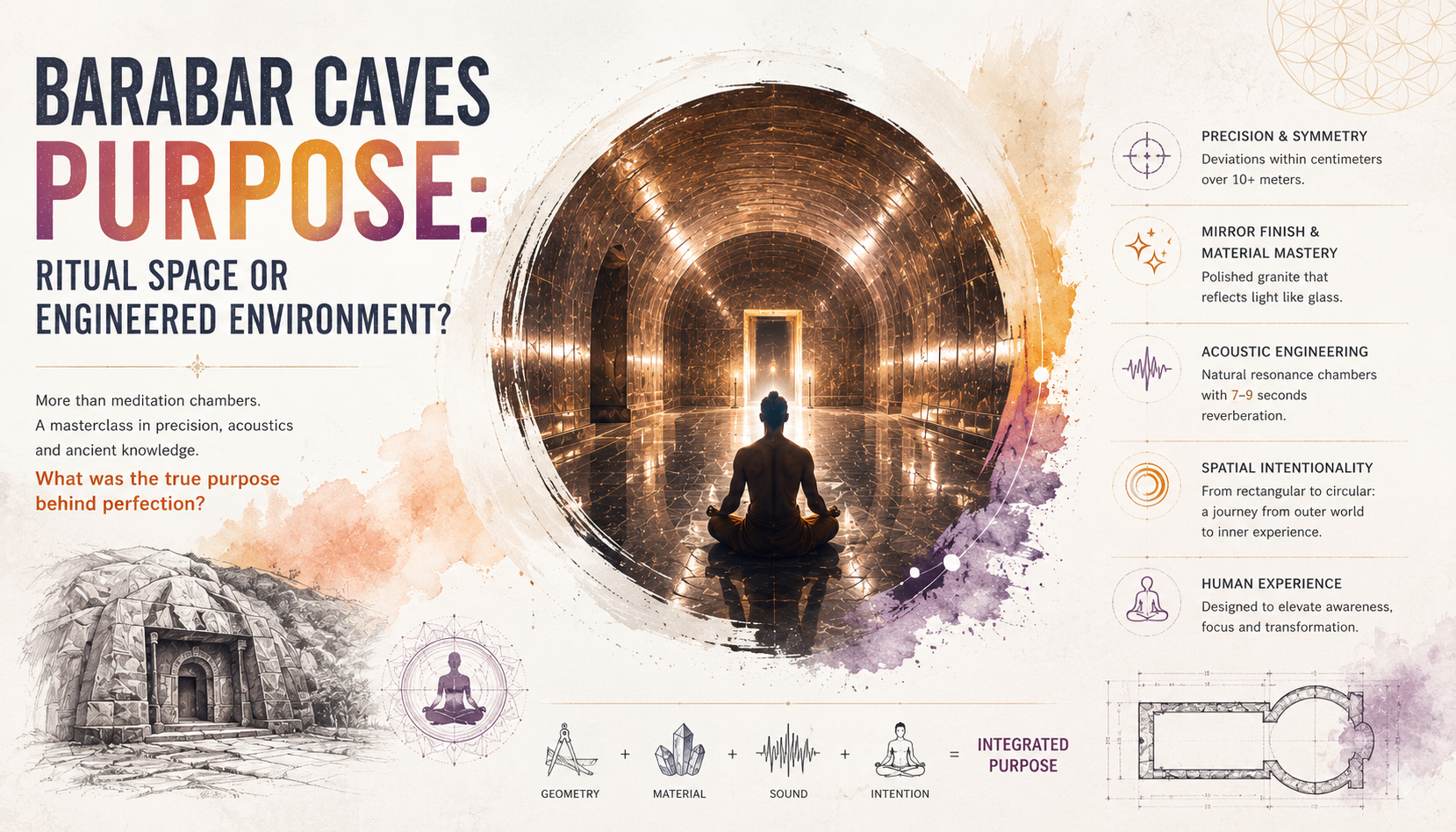
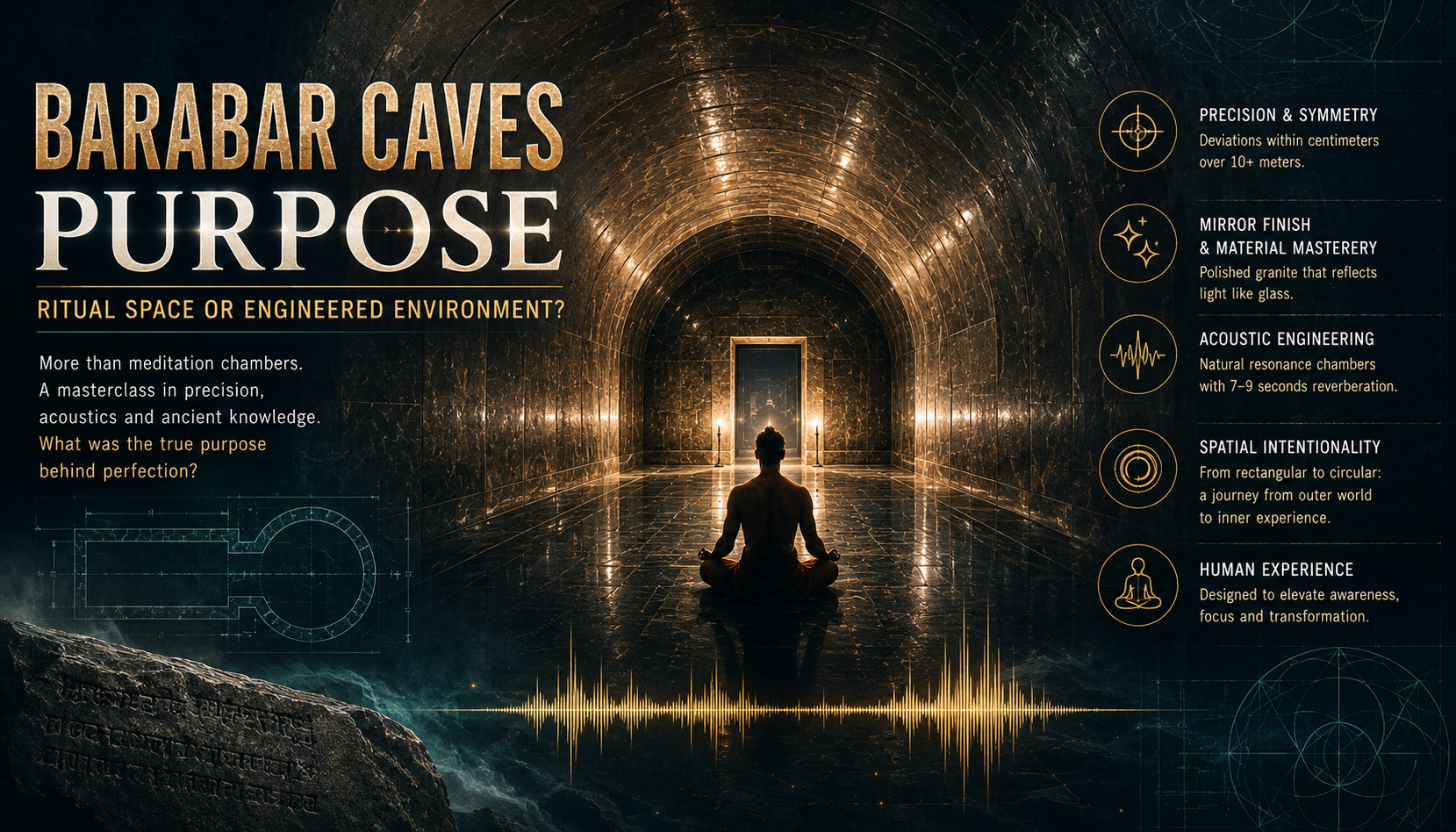
The Barabar Caves Purpose becomes increasingly intriguing when the physical characteristics of the chambers are examined. Unlike many ancient rock-cut structures, the interiors display an almost mirror-like polish across large expanses of hard granite. The walls, ceilings, and curved surfaces reflect light in a manner that continues to surprise visitors and researchers alike. The geometry appears deliberate, the surfaces unusually refined, and the acoustic effects immediately noticeable even to casual observers. These qualities have encouraged some investigators to ask whether the caves were designed for purposes extending beyond simple shelter or religious retreat. The question is not whether ritual activity occurred within the caves, but whether ritual use alone can account for the extraordinary engineering effort that produced them.
From a broader historical perspective, the caves also raise questions about the technological capabilities of ancient civilizations. Human history stretches back hundreds of thousands of years, while written records cover only a small fraction of that timeline. Throughout prehistory and antiquity, knowledge has been repeatedly lost, rediscovered, and transformed. Entire cultures disappeared without leaving extensive written accounts of their achievements. Within this framework, some researchers have suggested that the Barabar Caves may preserve evidence of technical traditions whose origins are no longer fully understood. Whether one accepts that possibility or not, the caves remain among the most sophisticated examples of ancient stoneworking ever produced.
Barabar Caves Purpose in Conventional Interpretation
Mainstream archaeology presents a clear and structured interpretation of the Barabar Caves Purpose. According to the conventional view, the caves were created as ascetic retreats for the Ajivikas, a spiritual movement that emphasized discipline, determinism, self-control, and renunciation. The caves provided isolated environments removed from the distractions of urban life, allowing practitioners to engage in meditation and philosophical reflection. This interpretation is supported by inscriptions attributed to Ashoka and later to his grandson Dasharatha Maurya, who dedicated several chambers to the Ajivika community. The historical evidence therefore establishes a strong connection between the caves and organized religious practice. Within this framework, the caves are understood primarily as sacred spaces designed to support contemplation and spiritual development (Barabar Caves Measurements article).
Key Evidence Supporting the Conventional Model
- Ashokan inscriptions dedicating caves to the Ajivikas
- Dasharatha Maurya inscriptions continuing the tradition
- Third-century BCE Mauryan dating
- Historical association with ascetic communities
- Similarities to later Indian rock-cut religious architecture
The conventional explanation fits comfortably within the broader history of Indian architecture. Throughout the subcontinent, numerous religious communities carved temples, monasteries, and meditation chambers directly into living rock. The Barabar Caves are often viewed as the earliest surviving expression of this tradition. However, the comparison also highlights important differences. Later cave complexes frequently contain decorative carvings, pillars, sculptures, and elaborate artistic programs. The Barabar chambers, by contrast, are strikingly minimalist. Their emphasis appears to be not on ornamentation but on precision, geometry, and surface finish. This distinction has led some researchers to question whether the engineering itself played a more important role than generally acknowledged.
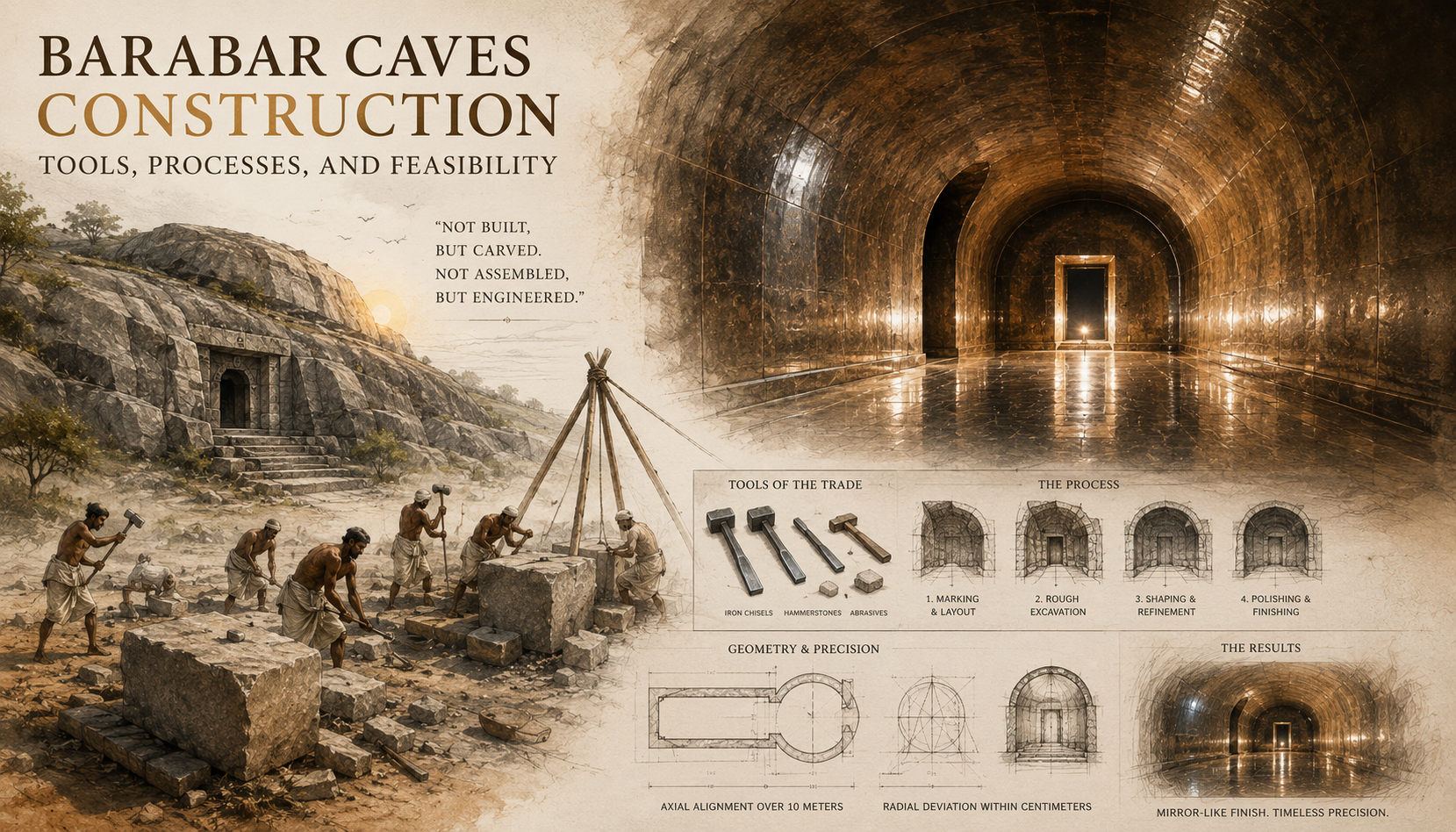
While the religious interpretation explains who occupied the caves, it leaves unanswered questions regarding execution. Producing such highly polished surfaces within hard granite would have required extensive planning, specialized tools, and an enormous investment of labor. The precision evident throughout the chambers appears to exceed what would be strictly necessary for a functional meditation retreat. This observation does not invalidate the traditional interpretation, but it suggests that additional factors may have influenced the design. Understanding the Barabar Caves Purpose therefore requires examining not only the historical context but also the engineering achievements embedded within the stone itself (Barabar Caves Polishing Mystery article).
Engineering Complexity and Functional Discrepancy
When evaluating the Barabar Caves Purpose through a technical lens, a noticeable discrepancy emerges between intended use and engineering effort. The interiors display an extraordinary level of refinement rarely encountered in ancient stone architecture. Visitors immediately notice the smoothness of the granite surfaces and the consistency of the curved walls. The chambers appear carefully planned rather than simply excavated. Every surface contributes to an impression of deliberate control, suggesting that geometry was considered a fundamental aspect of the design process. Such characteristics naturally invite questions about the methods and knowledge employed by the builders.
Notable Engineering Features
- Extensive granite polishing throughout interior chambers
- Consistent geometric forms and curved surfaces
- Long axial corridors and carefully aligned spaces
- Strong acoustic reflection and resonance effects
- Uniform finishing across large interior areas
From a practical perspective, these features represent a substantial investment of resources. Granite is one of the most difficult natural materials to shape and finish, requiring considerable effort even with modern equipment. Mainstream explanations propose that Mauryan craftsmen achieved these results using iron tools, abrasives, and highly organized labor. While this remains the accepted interpretation, the scale of the accomplishment continues to inspire debate. Some engineers and independent researchers have argued that the precision appears almost machine-like in its consistency. They do not necessarily propose modern machinery, but rather suggest that ancient stoneworking techniques may have been more sophisticated than commonly assumed.
This discrepancy between function and effort forms one of the central mysteries surrounding the Barabar Caves Purpose. If the primary objective was simply to create a place for meditation, why invest such extraordinary effort in achieving perfection within hard granite? Functional spaces do not inherently require mirror-like finishes or carefully controlled acoustic behavior. The hypothesis emerging from this observation is not that the caves lacked a ritual function, but that their purpose may have included additional dimensions that modern interpretations have yet to fully recognize. The engineering itself may have been part of the intended experience rather than merely a means of creating shelter (Barabar Caves Symmetry article).
Barabar Caves Purpose and Acoustic Functionality
One of the strongest arguments for a broader interpretation of the Barabar Caves Purpose lies in acoustics. Anyone entering the chambers quickly becomes aware that sound behaves differently inside these spaces. Voices resonate, echoes linger, and even small sounds seem amplified by the surrounding stone. These effects are particularly noticeable within the circular chambers, where curved surfaces contribute to unusual patterns of reflection. The acoustic qualities are so prominent that they have become one of the defining characteristics of the caves. This naturally raises questions about whether the phenomenon was intentional or simply an unintended consequence of the architecture.
Observed Acoustic Characteristics
- Pronounced echo effects
- Strong sound reflection from polished granite surfaces
- Resonance within enclosed chambers
- Enhanced auditory perception in specific locations
- Interaction between geometry and sound propagation
If the acoustic behavior was intentional, it may provide valuable clues regarding the original Barabar Caves Purpose. Religious traditions throughout history have used sound as a tool for altering perception, reinforcing ritual practices, and creating immersive experiences. Chanting, singing, and vocal recitation often become more powerful when performed within acoustically responsive environments. The Barabar chambers appear uniquely suited to such activities. Their geometry and polished surfaces transform sound into an active component of the environment rather than a passive byproduct of enclosed space.
From an alternative perspective, the acoustic properties may point toward a more sophisticated understanding of resonance than is generally assumed. Some researchers have suggested that ancient builders possessed practical knowledge of how shape, material, and sound interact. Such knowledge need not imply advanced technology in the modern sense. Instead, it may reflect generations of empirical observation and experimentation. Whether the acoustic effects were consciously engineered or discovered through accumulated experience remains uncertain. Nevertheless, they form an essential part of the caves’ identity and cannot easily be dismissed as incidental.
Spatial Design and Controlled Experience
Another important dimension of the Barabar Caves Purpose involves the way space itself is experienced by the individual moving through the chambers. The design is not simply a hollowed-out cavity in stone. Instead, the internal arrangement creates a sequence of experiences that unfolds gradually as one progresses deeper into the structure. In several caves, visitors pass through an elongated rectangular chamber before entering a circular or semi-circular inner space. This transition creates a noticeable shift in both visual perception and acoustic behavior. The movement from one environment to another appears intentional rather than accidental. As a result, the architecture guides experience rather than merely accommodating it.
Spatial Characteristics
- Linear entrance passages
- Circular or rounded interior chambers
- Controlled movement through space
- Progressive change in acoustics
- Deliberate transitions between environments
Architectural theorists often describe such arrangements as experiential design. In modern architecture, transitions between confined and expanded spaces are frequently used to influence emotional and psychological responses. The Barabar Caves appear to employ similar principles despite being more than two thousand years old. The narrowing and widening of space naturally affects orientation, attention, and awareness. Visitors often become more conscious of their surroundings as they move deeper into the chambers. The effect is subtle but powerful, suggesting that the spatial sequence itself may have been considered an essential component of the caves’ function.
The highly polished granite surfaces further amplify this experience. Light reflects differently across the smooth walls, creating visual effects rarely associated with ancient rock-cut architecture. Combined with the acoustic properties, the result is an environment that actively shapes perception. Whether this was intended for meditation, ritual practice, initiation ceremonies, or some other activity remains uncertain. What is clear is that the caves were designed in a manner that influences how individuals interact with space. This observation supports the possibility that the Barabar Caves Purpose extended beyond simple occupation and into the realm of carefully controlled experience (Barabar Caves Acoustics article).
Ritual Space vs Engineered Environment
The central debate surrounding the Barabar Caves Purpose can be framed as a comparison between two interpretive models. The first is the traditional ritual-space model, which views the caves primarily as religious retreats designed for ascetic communities. The second is the engineered-environment model, which suggests that the architecture itself was intended to produce specific sensory and experiential effects. While these models are often presented as competing explanations, they may in fact represent different aspects of the same phenomenon. Ancient cultures frequently integrated practical, spiritual, and technological considerations into a unified worldview. As a result, separating ritual from engineering may impose a modern distinction that did not exist for the original builders (Stone Functional Materials article).
Ritual Space Model
Primary Function
- Meditation
- Ascetic practice
- Religious retreat
- Philosophical contemplation
Engineering Role
- Supportive rather than central
- Intended to create durable sacred spaces
Engineered Environment Model
Primary Function
- Interaction between people and space
- Controlled acoustics
- Structured sensory experience
- Manipulation of perception through architecture
Engineering Role
- Fundamental to purpose
- Integral rather than secondary
When examined objectively, evidence exists that supports elements of both models. Historical inscriptions strongly support ritual use, while the measurable architectural features suggest extraordinary attention to engineering. The challenge lies in determining whether one explanation is sufficient on its own. The caves may represent a hybrid system in which spiritual practices were enhanced through deliberate manipulation of geometry, material, and sound. In such a framework, engineering and ritual become inseparable components of a single design philosophy. The significance of the caves would therefore lie not only in what occurred within them, but also in how the environment influenced those activities.
This possibility aligns with broader patterns found throughout the ancient world. Many monumental structures appear to combine symbolic meaning with practical engineering in ways that modern observers sometimes overlook. Sacred architecture often served multiple functions simultaneously. It communicated ideas, structured behavior, and altered perception while also fulfilling religious purposes. Viewed through this lens, the Barabar Caves Purpose may be better understood as the creation of an environment designed to facilitate specific experiences rather than merely provide shelter for spiritual practitioners (Reconstructing Lost Ancient Technologies article).
Barabar Caves Purpose and Knowledge Systems
When placed within a broader historical framework, the Barabar Caves Purpose may reflect the operation of integrated knowledge systems rather than isolated architectural decisions. Modern disciplines often separate engineering, mathematics, acoustics, philosophy, and psychology into distinct fields of study. Ancient societies frequently approached these subjects differently. Knowledge was often transmitted through traditions that blended practical techniques with cosmological and philosophical concepts. As a result, architectural achievements may represent the convergence of multiple forms of expertise rather than the application of a single specialized discipline.
Potential Knowledge Domains Involved
- Geometric planning
- Precision measurement
- Stoneworking techniques
- Acoustic awareness
- Spatial psychology
- Ritual design
The extraordinary polish of the granite surfaces alone implies a deep understanding of materials and finishing techniques. Achieving such results consistently across multiple chambers would have required more than brute labor. It would have demanded planning, organization, and a systematic approach to stoneworking. Likewise, the geometric consistency visible throughout the caves suggests familiarity with measurement and layout methods. Whether these techniques were developed locally, inherited from earlier traditions, or refined over generations remains unknown. Nevertheless, their existence demonstrates a sophisticated level of practical knowledge.
Some researchers have proposed that ancient civilizations possessed bodies of technical expertise that have been underestimated because they left few written records describing their methods. This does not necessarily imply lost high technology in the modern sense. Rather, it suggests the possibility that certain skills, techniques, and design principles were transmitted through apprenticeship and practice instead of formal documentation. Over centuries, such traditions can disappear, leaving only the finished structures as evidence of their existence. Within this framework, the Barabar Caves Purpose may represent the culmination of knowledge systems that are now only partially visible through archaeology.
The caves also demonstrate how architecture can function as a repository of information. Every polished surface, geometric alignment, and acoustic effect reflects a series of decisions made by the builders. These decisions encode practical knowledge within the structure itself. By studying the caves, researchers are effectively examining the surviving output of an ancient technical tradition. Whether that tradition was uniquely Mauryan or inherited from earlier sources remains one of the most intriguing questions surrounding the site.
Limits of Interpretation and Open Questions
Despite the remarkable characteristics of the Barabar Caves, caution remains essential when evaluating their significance. Many interpretations—both conventional and alternative—extend beyond what can be directly proven through available evidence. Archaeology provides valuable information regarding chronology, inscriptions, and cultural context, but it cannot always reveal the full intentions of ancient builders. The absence of detailed construction records means that many aspects of the caves remain open to interpretation. As a result, any discussion of the Barabar Caves Purpose must acknowledge the limits of current knowledge.
Current Limitations
- No surviving documents describing construction methods
- No direct explanation of design intent
- Acoustic properties may have changed over time
- Modern observers interpret ancient structures through contemporary frameworks
- Many assumptions remain difficult to test empirically
Several important questions continue to drive research and debate. Were the acoustic effects deliberately incorporated into the design, or were they simply a consequence of the chosen geometry? Did the builders possess specialized knowledge that has since been lost, or can their achievements be fully explained through known techniques? Was the remarkable precision primarily functional, symbolic, or aesthetic? Each possibility carries different implications for understanding the site. None can currently be demonstrated with complete certainty.
The absence of definitive answers should not be viewed as a weakness. On the contrary, it highlights the complexity of the caves and the need for continued investigation. Ancient monuments often reveal more questions as research progresses. The Barabar Caves are a prime example of this phenomenon. Their historical significance is undisputed, yet the deeper motivations behind their design remain elusive. It is precisely this combination of evidence and uncertainty that continues to attract interest from archaeologists, engineers, historians, and independent researchers alike.
Barabar Caves Purpose in the Context of Deep History
When viewed against the broader timeline of human existence, the Barabar Caves invite a perspective that extends beyond conventional historical boundaries. Modern humans have existed for more than 300,000 years, while recorded history occupies only a small portion of that span. During this immense timeframe, countless cultures emerged, evolved, and disappeared. Environmental change, migration, conflict, and natural disasters repeatedly reshaped human societies. It is therefore reasonable to consider the possibility that significant amounts of knowledge have been lost over time. The archaeological record preserves only fragments of humanity’s full story.
Deep-History Possibilities
- Knowledge traditions may have been transmitted orally
- Technical skills could have disappeared with social collapse
- Architectural methods may have survived longer than written records
- Practical expertise may have been preserved through apprenticeship
- Ancient innovations may have been repeatedly rediscovered
Within this framework, the Barabar Caves Purpose may represent more than a single historical achievement. The caves could be viewed as a surviving expression of accumulated knowledge refined across generations. The extraordinary workmanship visible in the granite may reflect traditions whose developmental history is no longer accessible. Such a possibility does not require the existence of advanced machines or forgotten industrial civilizations. Instead, it suggests that human capabilities in the ancient world may have been more sophisticated than modern assumptions sometimes allow.
This perspective also encourages humility when interpreting the past. The absence of evidence is not always evidence of absence. Many ancient technologies were based on practical knowledge rather than written theory. If those traditions disappeared, the structures themselves may be the only surviving testimony to their existence. Whether one accepts this broader interpretation or not, the Barabar Caves demonstrate that ancient builders were capable of achieving results that continue to inspire admiration and debate. Their existence challenges simplistic narratives of technological progress and reminds us that human ingenuity has deep roots extending far beyond recorded history (Climate History of the Last 40,000 Years article).
Conclusion
The Barabar Caves Purpose cannot be reduced to a single explanation without oversimplifying the evidence. Historical inscriptions clearly indicate that the caves were associated with the Ajivika community and functioned as spaces for religious activity during the Mauryan period. At the same time, the remarkable precision of the granite surfaces, the sophisticated geometry of the chambers, and the unusual acoustic behavior suggest a level of intentional design that extends beyond basic utility. These characteristics indicate that the builders were concerned not only with creating enclosed spaces, but also with shaping the experiences of those who entered them.
The debate is therefore not between ritual and engineering, but between narrow and broader interpretations of purpose. The available evidence allows for the possibility that the caves were both sacred environments and highly controlled architectural systems. Sound, geometry, material, and movement appear to work together in ways that influence perception and interaction. Whether these effects emerged through deliberate design, accumulated tradition, or a combination of both remains uncertain. What is clear is that the caves represent one of the most impressive achievements of ancient stoneworking known from the historical record.
Viewed through the lens of deep history, the Barabar Caves may also serve as a reminder that much of humanity’s technological and intellectual heritage remains hidden from view. Knowledge can be preserved, transformed, forgotten, and rediscovered across generations. The caves stand as enduring evidence of capabilities that continue to challenge assumptions about the ancient world. Rather than offering simple answers, they invite ongoing investigation into the relationship between architecture, engineering, ritual practice, and human perception. In this sense, the Barabar Caves remain not only monuments of the past, but also gateways to questions that have yet to be fully answered.
References and Further Reading
Archaeological Survey of India (ASI) – Official surveys, inscriptions, and site documentation
Upinder Singh, A History of Ancient and Early Medieval India
D.C. Sircar, Select Inscriptions Bearing on Indian History and Civilization
K.V. Soundara Rajan, studies on Indian rock-cut architecture
Research papers examining acoustics in ancient ritual spaces
Andrija Puharich, writings on resonance and human perception
Studies on Mauryan architecture and stone-polishing techniques
ResearchGate – Studies on ancient acoustics and resonance (link)
Andrija Puharich – Sacred Mushroom Key to the Door of Eternity (link)
Seed of Knowledge, Stone of Plenty (link)
ResearchGate Mirror-Polished Granite Caves -Barabar Hills (link)
Ancient Hyper Forests and Giant Trees (link)
Pre Flood Civilization and Environmental Collapse (link)
Was the Ancient World Phisically Different? (link)
Giant Humans Before the Younger Dryas (link)
Ancient Construction Project Management (link)
Ice Age Civilization Lost Worlds Before Floods (link)
Lost Knowledge of Ice Age Rewritten History (link)
Ice Age Knowledge Science Before Younger Dryas (link)
Geometry and Earth Scaling (link)
How Ancient Builders Measured the Stars (link)