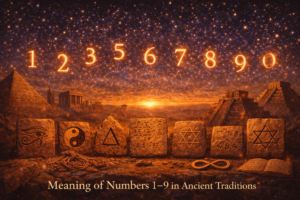
Meaning of Numbers 1–9: Sacred Numbers in Ancient Traditions
The meaning of numbers 1-9 appears repeatedly in ancient traditions across the world. From Egyptian temple symbolism to Greek philosophy and Asian cosmology, these single-digit numbers were considered the fundamental building blocks of both mathematics and metaphysical knowledge.
In many early cultures, numbers were not merely tools used for counting or measuring. Instead, they were believed to reflect deeper structures governing the universe. Philosophers, priests, and initiates studied the meaning of numbers 1–9 to understand cosmic order, natural cycles, and the relationship between humanity and the cosmos (Nicomachus of Gerasa – Introduction to Arithmetic (link).
Because every larger number ultimately reduces to a single digit in many numerological systems, the meaning of numbers 1–9 formed the foundation of ancient numerical philosophy. These numbers represented universal principles that appeared in mythology, architecture, astronomy, and sacred geometry (The Theology of Arithmetic by Iamblichus link).
Across civilizations—from Egypt and Mesopotamia to India, China, and the Americas—the same numbers often carried similar symbolic meanings. This recurring pattern has led some researchers to suggest that ancient cultures may have inherited fragments of older knowledge traditions preserved through myths, oral histories, and initiatory schools (Timaeus of Plato link).
Why the Meaning of Numbers 1–9 Was Considered Sacred
Ancient mathematical traditions recognized that all numbers originate from combinations of the digits 1 through 9. Because of this property, many early philosophers believed these numbers represented fundamental cosmic principles.
In traditions associated with the teachings of Pythagoras, numbers were seen as the essence of reality itself. Every phenomenon—music, geometry, planetary motion—was thought to follow numerical relationships.
For initiatory schools in many ancient cultures, studying the meaning of numbers 1–9 became a method of exploring universal order. Numbers were seen as symbolic expressions of the forces shaping existence.
The Meaning of Number 1
Within the meaning of numbers 1–9, the number one represents unity and origin. Across ancient traditions, it symbolized the beginning of all things. Philosophically, the number one represented the undivided source from which all other numbers emerge. In many cosmological myths, creation begins with a singular divine principle or primordial force. The number one therefore came to symbolize:
-
unity
-
origin
-
creation
-
divine source
Ancient philosophers often described this number as the point from which all multiplicity unfolds.
The Meaning of Number 2
The number two introduced the concept of duality. Within the meaning of numbers 1–9, two symbolized polarity and balance. Many ancient cosmologies described reality as emerging from the interaction between opposing forces. Examples include:
-
light and darkness
-
masculine and feminine
-
order and chaos
Chinese philosophy expresses this dual principle through the symbolic concept of yin and yang.
The number two therefore represents division, contrast, and the dynamic relationships that shape the universe.
The Meaning of Number 3
In many cultures, three symbolizes harmony and synthesis. Within the meaning of numbers 1–9, three represents the resolution of duality. After the tension created by two opposing forces, the number three brings balance and creative expression. This symbolism appears frequently in ancient mythologies and philosophical systems.
Examples include:
-
birth, life, and death
-
heaven, earth, and humanity
-
past, present, and future
The number three also appears frequently in sacred architecture and ritual traditions.
The Meaning of Number 4
The number four represents structure and stability. Within the meaning of numbers 1–9, four is often associated with the physical world and the organization of natural systems.
Examples include:
-
four cardinal directions
-
four seasons
-
four classical elements
Because of its association with order and stability, the number four frequently appears in temple design and sacred geometry.
The Meaning of Number 5
Five often symbolizes life, movement, and the human experience. In many ancient traditions, the meaning of numbers 1–9 associates the number five with humanity itself. This symbolism may derive from the human form, which can be represented by five extensions: head, arms, and legs.
The number five also appears in philosophical systems describing natural balance. Examples include:
-
the five elements in Chinese cosmology
-
the five senses of human perception
Because of these associations, the number five often represents dynamic interaction between humanity and nature.
The Meaning of Number 6
Within the meaning of numbers 1–9, six is frequently associated with harmony and equilibrium. Mathematically, six has interesting properties as a “perfect number,” meaning that the sum of its divisors equals the number itself.
In symbolic traditions, six often represents balance between opposing forces and the harmonious structure of natural systems. Some ancient architectural designs incorporate sixfold symmetry, reflecting this association with balance.
The Meaning of Number 7
Few numbers appear as frequently in ancient traditions as seven. Within the meaning of numbers 1–9, seven is widely associated with spirituality, mystery, and cosmic order.
Examples appear across many cultures:
-
seven classical planets in ancient astronomy
-
seven days in the week
-
seven heavens in various cosmologies
Because of these associations, seven became a symbol of spiritual knowledge and cosmic harmony.
The Meaning of Number 8
The number eight often represents cycles and regeneration. Within the meaning of numbers 1–9, eight is associated with continuity and renewal. Its symmetrical shape has also been interpreted as representing infinite flow.
In some Asian traditions, eight symbolizes prosperity and transformation. Ancient cosmologies sometimes associated the number eight with cyclical patterns in nature, including seasonal transitions and astronomical cycles.
The Meaning of Number 9
Nine represents completion and culmination. Within the meaning of numbers 1–9, nine marks the final stage before numerical cycles begin again with ten.
Because nine contains the previous numbers within its structure, it has often been interpreted as representing wisdom, fulfillment, and the completion of a cycle.
Many ancient traditions associated nine with cosmic order and higher knowledge.
Sacred Numbers and the Transmission of Ancient Knowledge
The recurring symbolism associated with the meaning of numbers 1–9 raises an intriguing historical question. Why do similar interpretations appear in cultures separated by vast distances?
Some scholars suggest these parallels result from universal human patterns of thought. Others propose that early civilizations may have inherited fragments of older knowledge traditions preserved through mythology, oral storytelling, and symbolic architecture.
Ancient schools of initiates—whether priestly colleges, philosophical communities, or temple traditions—often guarded symbolic teachings about numbers, geometry, and cosmic order.
In this context, the meaning of numbers 1–9 may represent a symbolic language through which early civilizations transmitted knowledge across generations.
Conclusion
The meaning of numbers 1–9 reveals how deeply numerical symbolism influenced ancient traditions. Far from being simple counting tools, numbers were understood as expressions of universal order. Across cultures and continents, the same single-digit numbers appeared in mythology, architecture, cosmology, and philosophical teachings.
Whether these similarities arose independently or reflect fragments of older shared knowledge traditions remains an open question. What is certain is that numbers played a central role in humanity’s earliest attempts to understand the structure of the universe.
Further Reading and Sources
Readers interested in exploring the historical background of numerical symbolism can consult the following classical and modern sources. These works discuss the philosophical, mathematical, and symbolic traditions connected to the meaning of numbers 1–9.
Classical Sources
-
Introduction to Arithmetic by Nicomachus of Gerasa – An influential ancient text describing the philosophical properties of numbers within the Pythagorean mathematical tradition.
-
The Theology of Arithmetic by Iamblichus – A classical work that explores the symbolic meanings of numbers in late Pythagorean and Neoplatonic philosophy.
-
Timaeus by Plato – A philosophical dialogue discussing cosmology, mathematics, and the numerical harmony underlying the structure of the universe.
Modern Studies
-
A Beginner’s Guide to Constructing the Universe by Michael S. Schneider – A modern exploration of sacred geometry, number symbolism, and mathematical patterns in art and architecture.
-
Number Words and Number Symbols by Karl Menninger – A historical study of how numbers and number symbols developed across cultures.
Related Topics
Readers may also wish to explore related fields such as:
These traditions provide valuable insight into how ancient civilizations interpreted numbers not only as mathematical tools, but also as symbolic expressions of cosmic order.