A Forgotten Cold Pulse in the Last Ice Age
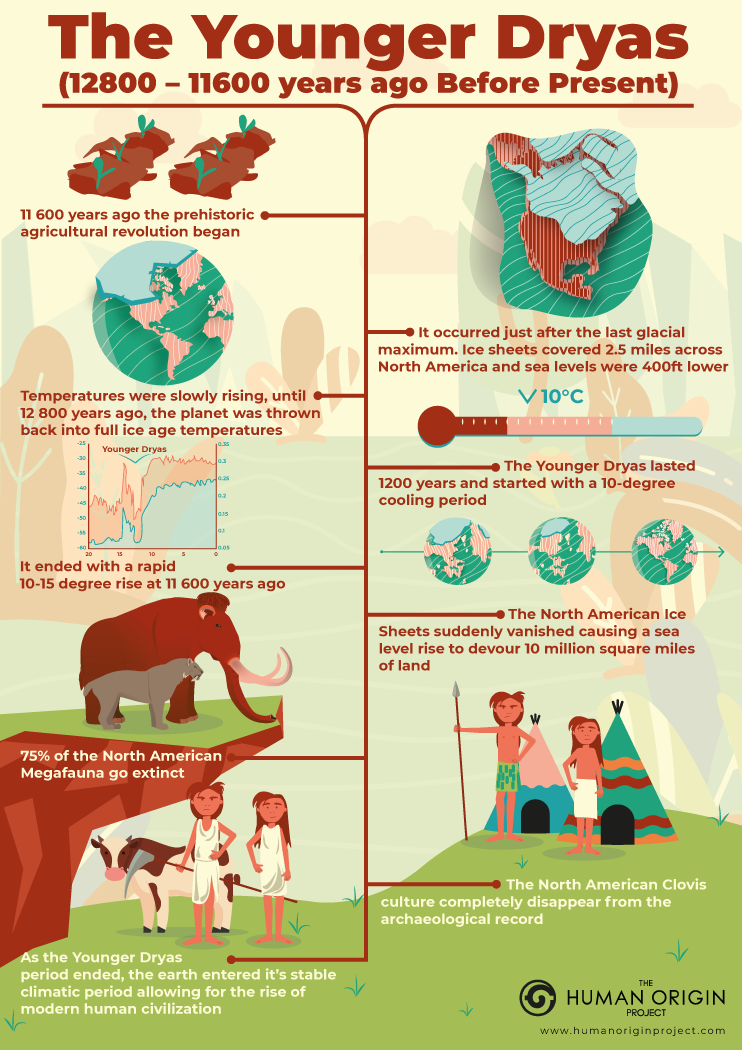
Before the dramatic Younger Dryas, there was the Older Dryas climate shift — a quieter yet equally revealing chapter in Earth’s late Ice Age story. Occurring roughly 14,000–13,700 BCE, this short-lived cooling event interrupted the planet’s first major warming after the Last Glacial Maximum.
It was a climatic hiccup that warned of the planet’s volatility — a prelude to the later, catastrophic Younger Dryas. Scientists now view it as a vital key to understanding how fragile Earth’s climate systems truly are.
The Dryas Flower and the Language of Ice
The name “Dryas” comes from Dryas octopetala, an alpine wildflower that thrives in tundra environments. When its pollen appears abundantly in lake sediments and ice cores, it marks a return to cold conditions.
Thus, both Older and Younger Dryas periods are identified not through myth or guesswork, but through botanical and isotopic fingerprints — tiny biological signals preserved in Greenland’s frozen layers.
Climate Shifts and Ocean Currents — The Great Conveyor Falters
During the Older Dryas, evidence suggests that vast meltwater pulses from retreating North American ice sheets flowed into the North Atlantic, likely through the St. Lawrence River system. This sudden influx of freshwater disrupted the Atlantic Meridional Overturning Circulation (AMOC) — the oceanic conveyor that drives warm water northward.
When this system faltered:
-
Ocean heat transport collapsed.
-
Sea ice expanded rapidly.
-
Global temperatures dropped by 4–6°C in mere decades.
This was not a gradual change — it was a flip of a planetary switch.

The Dance Between Cold and Warm — A Climate Whiplash
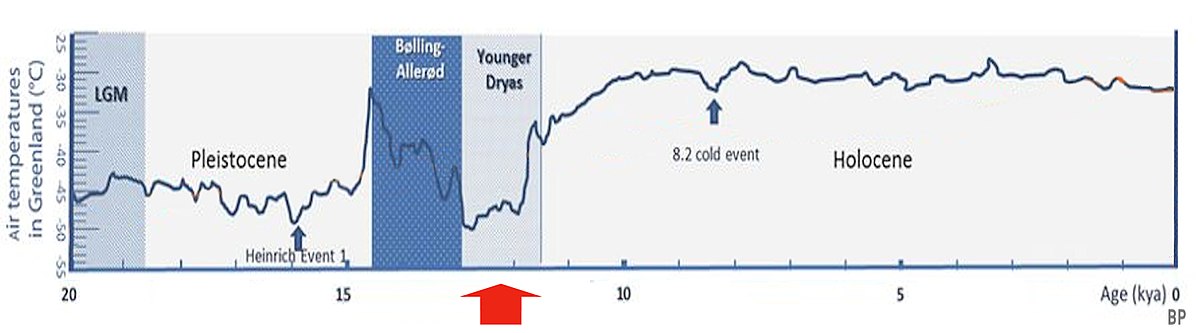
The Older Dryas was brief, lasting perhaps 200–300 years, before temperatures spiked again during the Bølling-Allerød interstadial — one of the warmest phases before the Younger Dryas freeze. In essence:
-
Around 14,700 BCE, the Earth warmed rapidly.
-
Around 14,000 BCE, it plunged into the Older Dryas cold.
-
Around 13,700 BCE, it warmed again, only to collapse once more during the Younger Dryas around 10,800 BCE.
This sequence reveals a climate caught in a delicate tug-of-war — one that could be tipped by volcanic eruptions, oceanic pulses, or even extraterrestrial factors.
Signals in Ice and Sediment — What the Data Reveal
Modern research in Greenland, Antarctica, and northern Europe reveals:
-
Greenland Ice Core Data (GRIP, GISP2): Sharp spikes in δ¹⁸O isotopes indicate a sudden cooling of up to 6°C.
-
European Pollen Records: Expansion of tundra flora, particularly Dryas octopetala, alongside a retreat of birch and pine species.
-
Lake Varves in Scandinavia: Increased sedimentation rates, linked to glacial re-advances.
-
Dust Layers: Indicating aridity and decreased vegetation cover across northern latitudes.
These records suggest the Older Dryas was a real, global-scale climate anomaly, not a localized event.
Possible Triggers — From Volcanoes to Meltwater Floods
The cause remains debated, but leading theories include:
-
Volcanic Activity: A major eruption or series of eruptions could have ejected enough aerosols to reflect sunlight and cool the atmosphere.
-
Meltwater Disruption: Sudden drainage of glacial lakes (like Lake Agassiz) into the North Atlantic disrupted thermohaline circulation.
-
Cosmic Perturbations (Speculative): Some researchers, including Randall Carlson and Graham Hancock, propose that Earth’s climate instability during this era may reflect a recurring cycle of impacts or near-Earth events, setting the stage for the later Younger Dryas impact.
Archaeological Echoes — Human Adaptation Before Collapse
During the Older Dryas, human societies were in transition:
-
Europe: The Magdalenian culture continued its artistic and toolmaking brilliance but faced ecological stress.
-
Levant: The Epipaleolithic peoples of the Natufian culture began experimenting with proto-agriculture, only to be disrupted by climate instability.
-
Asia and the Americas: Populations migrated along shifting river valleys and coastlines, tracking game herds and resources.
These patterns suggest humanity was already adapting to a volatile planet long before the Younger Dryas struck its final blow.
From the Older Dryas to the Younger Dryas — A Planet Poised on the Edge
In hindsight, the Older Dryas looks like a warning shot. It tested Earth’s systems — and when those systems failed again a few millennia later, the result was catastrophic.
The Younger Dryas didn’t come out of nowhere; it was the second movement in a climatic symphony of chaos, the crescendo of feedback loops already in motion. When the final pulse hit, it pushed ecosystems, ocean currents, and early human cultures past their breaking point.
Echoes in Myth and Memory
Although no written records exist from the Older Dryas, its echoes may live on in the pre-Flood traditions that later emerged worldwide:
-
Sumerian and Akkadian texts speak of earlier deluges before the great one.
-
Egyptian chronology hints at cyclical destructions tied to the “rising and setting of the star Sirius.”
-
Mesoamerican calendars encode precessional cycles, possibly preserving knowledge of earlier climate resets.
Perhaps these stories of “the world that came before” trace their roots to this early Dryas pulse — an event that shattered stability and etched itself into the collective memory of humankind.
Modern Lessons from Ancient Ice
Today, the study of the Older Dryas reminds scientists how abrupt and nonlinear climate can be. It warns that massive changes can unfold within a single human lifetime — something echoed in modern climate studies and AMOC weakening research.
The lesson from 14,000 years ago is clear: Earth’s equilibrium is fragile. And civilization — whether Magdalenian or modern — depends on the thin margin of climatic grace.
Links and References
- NOAA – The Younger Dryas
-
[Alley, R. B. (2000). The Younger Dryas Cold Interval as Viewed from Central Greenland]
-
Broecker, W. S. (1997): Thermohaline Circulation and Climate Stability
- Article: The Younger Dryas Impact Hypothesis Explained
- Article: The Cataclysm that Reset Civilization