Introduction: The Hidden Meaning of Sacred Numbers
Across the ancient world, sacred numbers were believed to reveal the hidden architecture of reality. To many early civilizations, numbers were far more than practical tools for counting or measuring—they were symbols that expressed the structure of the cosmos itself. Philosophers, priests, astronomers, and architects saw patterns in the movements of the heavens, the rhythms of nature, and the proportions of sacred buildings. These patterns were encoded through sacred numbers, mathematical relationships thought to reflect the underlying order of the universe.
From Mesopotamian astronomers to Egyptian temple builders and Greek philosophers, numerical symbolism played a central role in how humanity understood existence. Certain numbers appeared repeatedly in myths, rituals, architecture, and calendars, suggesting that ancient thinkers believed reality itself was governed by mathematical harmony. The idea that numbers shape the cosmos continues to influence modern science, philosophy, and spiritual traditions.
Understanding the role of sacred numbers allows us to explore how ancient civilizations attempted to decode the universe using mathematics long before the emergence of modern scientific theory.
The Origins of Sacred Numbers in Ancient Thought
The concept of sacred numbers emerged alongside the earliest mathematical systems developed by ancient civilizations. As humans began observing the cycles of the moon, the changing seasons, and the movements of stars and planets, they discovered that these phenomena followed predictable numerical patterns.
Early cultures did not separate mathematics from spirituality. Instead, numbers were viewed as part of the divine structure of reality. Observations of nature suggested that numerical relationships governed both the heavens and the Earth.
For example, lunar cycles last roughly twenty-nine days, seasons repeat in yearly patterns, and constellations shift according to predictable astronomical cycles. These observations encouraged ancient scholars to believe that numbers were the fundamental language of the universe.
In many early societies, priests and astronomers became guardians of this knowledge. They used numerical patterns to construct calendars, design temples, and determine the timing of religious rituals. Over time, specific numbers became associated with cosmic principles such as balance, creation, harmony, and completion.
Sacred Numbers and the Birth of Mathematical Cosmology
As civilizations advanced, the study of sacred numbers gradually evolved into philosophical systems that attempted to explain the structure of the universe itself. The most famous example emerged in ancient Greece through the teachings of Pythagoras and his followers.
Pythagorean philosophy proposed that numbers were not merely symbols but the fundamental building blocks of reality. According to this view, the cosmos itself was structured through numerical relationships that produced harmony and balance.
One of the most powerful examples of this belief was the discovery of mathematical ratios in music. When strings of different lengths vibrate, they produce harmonious musical intervals based on simple numerical ratios such as 2:1 or 3:2. For Pythagoreans, this demonstrated that harmony could emerge directly from mathematics.
This insight led to the idea of a cosmic harmony, sometimes called the “music of the spheres,” in which planetary movements were thought to follow numerical relationships similar to musical harmonies.
Although modern science no longer supports this literal interpretation, the idea that mathematical laws govern the universe remains central to physics and cosmology today.
Sacred Numbers in Ancient Civilizations
Many ancient cultures developed their own interpretations of sacred numbers, often associating particular numbers with divine forces or cosmic principles.
Mesopotamia
The civilizations of Mesopotamia used a base-60 numerical system that influenced many aspects of modern measurement, including the sixty-minute hour and the 360-degree circle. The number sixty itself was considered highly significant because of its mathematical versatility.
Egypt
In ancient Egypt, numerical symbolism appeared throughout temple design, religious rituals, and funerary texts. Certain numbers were associated with cosmic order and divine authority. Egyptian pyramid construction also relied heavily on precise mathematical proportions, suggesting a strong connection between architecture and numerical harmony.
China
Chinese philosophy developed sophisticated numerological systems connected to cosmology and natural balance. Concepts such as Yin and Yang and the Five Elements were often represented through numerical relationships that described cycles of transformation within the universe.
Mesoamerica
The Maya civilization created extremely advanced calendar systems based on numerical cycles that tracked astronomical events with remarkable precision. Their use of the number twenty as a base system influenced both mathematics and cosmology.
These diverse traditions demonstrate that the concept of sacred numbers appeared independently across multiple cultures, suggesting a universal human tendency to search for mathematical patterns in the natural world.
Sacred Numbers and Sacred Geometry
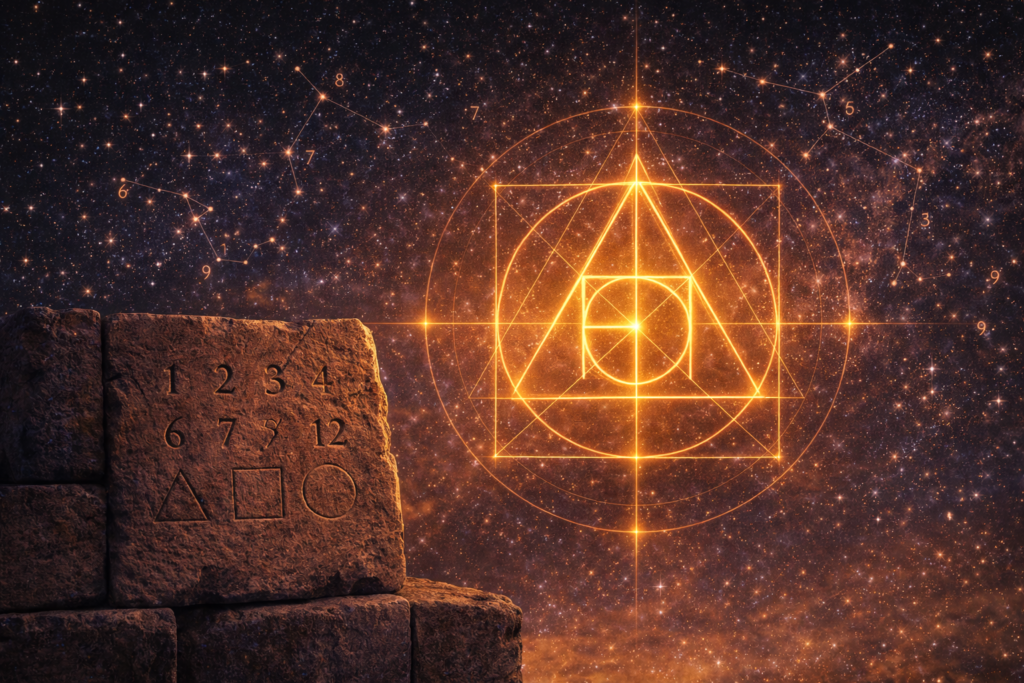
One of the most fascinating applications of sacred numbers appears in the field now known as sacred geometry. This concept describes the use of mathematical proportions and geometric patterns believed to reflect the fundamental structure of the universe.
Ancient architects and artists frequently incorporated geometric forms such as circles, triangles, and squares into sacred buildings and ritual spaces. These shapes were not chosen randomly; they represented deeper cosmological ideas.
For example, the circle often symbolized unity and infinity, while the square represented stability and the material world. Combining these shapes in architectural design symbolized the connection between heaven and Earth.
Mathematical ratios such as the golden ratio have also been linked to sacred geometry. Although modern scholars debate the extent of its use in antiquity, many ancient structures appear to follow proportional systems that produce aesthetic harmony.
Sacred geometry demonstrates how sacred numbers could be translated into physical form through architecture, art, and design.
Sacred Numbers in Religious Traditions
Religious traditions across the world frequently use sacred numbers to structure myths, rituals, and symbolic systems.
Certain numbers appear repeatedly in religious texts and spiritual traditions. The number three often represents balance or divine unity, while the number seven is associated with completeness or cosmic order.
These numerical symbols often shape religious storytelling. Myths may describe three trials, seven heavens, or twelve divine figures. These patterns help create symbolic frameworks that reinforce spiritual teachings.
In many traditions, sacred numbers also influence ritual practice. Prayer cycles, ceremonial timings, and sacred calendars often rely on numerical structures that reflect cosmological beliefs.
Through these symbolic systems, numbers become tools for connecting human experience with the perceived order of the cosmos.
Sacred Numbers in Architecture and Measurement
Ancient architecture offers some of the most tangible evidence for the importance of sacred numbers in early civilizations. Monumental structures such as temples, pyramids, and ceremonial complexes were frequently designed according to precise mathematical proportions.
These proportions were not purely aesthetic. Many builders believed that constructing sacred spaces according to numerical harmony could align human structures with cosmic order.
Measurements used in architecture often reflected symbolic numbers connected to astronomy, cosmology, or religious doctrine. Builders carefully planned layouts, orientations, and dimensions to reflect these numerical relationships.
For example, many ancient temples align with solar events such as solstices or equinoxes. These alignments required sophisticated knowledge of astronomy and mathematics.
The integration of sacred numbers into architecture suggests that ancient societies saw mathematical harmony as a bridge between human civilization and the larger universe.
Sacred Numbers and the Structure of Time
Timekeeping systems provide another example of how sacred numbers shaped ancient worldviews. Early calendars often combined astronomical observation with symbolic numerical cycles.
Many civilizations organized time using recurring numerical structures that reflected celestial patterns. Lunar months, solar years, and planetary cycles were translated into calendar systems used for agriculture, ritual events, and political organization.
These timekeeping systems frequently incorporated sacred numbers believed to represent cosmic balance or divine order. The repetition of numerical cycles reinforced the idea that time itself followed a structured pattern governed by universal laws.
Understanding these systems reveals how ancient cultures attempted to synchronize human life with the rhythms of the cosmos.
The Enduring Legacy of Sacred Numbers
Although modern science approaches mathematics from a different perspective, the legacy of sacred numbers continues to shape human thought. The idea that the universe follows mathematical laws remains one of the foundational principles of modern physics.
Scientists today describe reality through equations that model the behavior of matter, energy, and space-time. While ancient philosophers framed numerical patterns as expressions of divine order, modern researchers interpret them as natural laws governing the universe.
Yet the underlying insight remains remarkably similar: mathematics appears deeply embedded in the structure of reality.
The study of sacred numbers therefore provides a fascinating window into the origins of mathematical thinking. By examining how ancient civilizations understood numbers as cosmic symbols, we gain insight into humanity’s enduring quest to understand the universe through patterns, proportions, and numerical harmony.
Conclusion
Throughout history, civilizations across the world have recognized patterns that suggested a mathematical structure underlying the cosmos. These insights gave rise to the idea of sacred numbers, numerical relationships believed to encode the fundamental order of reality. Whether expressed through architecture, philosophy, religion, or astronomy, sacred numbers shaped how ancient cultures interpreted the universe. Although modern science has transformed our understanding of mathematics, the search for numerical patterns continues to guide scientific discovery today.
The story of sacred numbers reminds us that humanity’s desire to uncover the hidden structure of the cosmos is far older than modern science—and that mathematics has long served as a bridge between observation, philosophy, and cosmic wonder. The investigation of sacred numbers reveals a worldview in which mathematics, cosmology, religion, and architecture were deeply interconnected. Early civilizations did not view numbers merely as tools for calculation. They perceived them as expressions of universal harmony capable of revealing the hidden order of the cosmos.
From the musical ratios explored by Pythagorean philosophers to the astronomical cycles recorded by ancient astronomers, numerical relationships provided a framework through which humanity attempted to understand its place in the universe. The monuments left behind by these civilizations — pyramids, temples, stone circles, and calendars — serve as enduring reminders of this intellectual tradition. They suggest that the ancient world saw mathematics not only as a science but as a language capable of describing the architecture of reality itself.
The following articles in this series will explore how specific sacred numbers shaped architecture, astronomy, measurement systems, and religious traditions across cultures.
Additional Reading and Sources
Recommended historical and academic references for deeper study:
Heath, Thomas – A History of Greek Mathematics
Neugebauer, Otto – The Exact Sciences in Antiquity
Eliade, Mircea – The Sacred and the Profane
Krupp, Edwin – Echoes of the Ancient Skies (link)
Joseph Campbell – The Masks of God (link)
Ancient360 – Sacred Geometry in Architecture
Ancient360 – Aligning Earth and Sky (link)
Ancient360 – Cycles of Time (link)
Ancient360 – Lost Geometry Knowledge (link)