Sacred Number 7: The Mystical Number of the Ancient World
Across the entire landscape of ancient civilizations, few numbers appear as frequently and as symbolically powerful as the sacred number 7. From astronomy and mythology to religion, philosophy, and cosmology, the sacred number 7 appears again and again in traditions separated by vast distances of geography and time (Sacred Numbers Codes in Ancient Civilizations). Its persistent presence across cultures raises a compelling question that researchers, historians, and students of ancient knowledge continue to explore: why did so many civilizations regard the number seven as a number of cosmic importance?
The sacred number 7 emerges in early systems of astronomical observation, in sacred texts and religious symbolism, and in the structure of mythological cosmologies. It appears in the seven classical planets observed by ancient astronomers, in the seven days of the week that structure human timekeeping, and in countless mythological narratives describing seven heavens, seven worlds, or seven divine forces shaping the universe (Mathematical Blueprint of Cosmos).
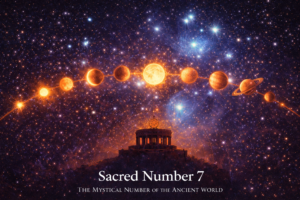
Unlike numbers derived purely from mathematical abstraction, the sacred number 7 appears to originate from a combination of celestial observation and symbolic interpretation, suggesting that ancient civilizations perceived the number as a reflection of natural cosmic order. The sky itself offered early observers a set of seven moving celestial bodies visible to the naked eye: the Sun, the Moon, Mercury, Venus, Mars, Jupiter, and Saturn. These wandering stars formed the basis of early planetary astronomy and became deeply embedded in cultural traditions across the ancient world.
Because of this connection between observable astronomy and symbolic cosmology, the sacred number 7 became one of the most enduring numerical archetypes in human history. Its presence in religious traditions, sacred architecture, mythological narratives, and philosophical systems suggests that ancient civilizations believed the universe itself was structured according to numerical principles that could be observed, interpreted, and encoded into culture.
Sacred Number 7 in Ancient Astronomy
The astronomical origins of the sacred number 7 are among the most widely accepted explanations for its symbolic significance. Long before the invention of telescopes, ancient sky watchers carefully observed the night sky and recognized that certain celestial bodies moved differently from the fixed stars (Star Maps of the Ancients).
While most stars remained in fixed patterns, seven luminous bodies moved across the sky in complex paths. These wandering celestial lights became known in ancient Greek as planetes, meaning wanderers, and eventually gave rise to the modern word planet. The seven classical celestial bodies recognized in antiquity were:
-
the Sun
-
the Moon
-
Mercury
-
Venus
-
Mars
-
Jupiter
-
Saturn
These seven visible celestial bodies formed the foundation of early cosmological systems. Ancient astronomers in Mesopotamia, Egypt, Greece, and India developed elaborate models describing the movement of these bodies through the heavens.
Because these seven celestial bodies appeared to influence seasonal cycles, tides, agricultural rhythms, and celestial alignments, many ancient cultures interpreted them as divine forces governing the cosmos. This connection between astronomy and symbolism gave rise to the idea that the sacred number 7 represented the fundamental structure of the universe.
Sacred Number 7 and the Seven-Day Week
One of the most familiar expressions of the sacred number 7 is the seven-day week, a system that has survived for thousands of years and remains embedded in modern global culture.
The origins of the seven-day week can be traced to ancient Mesopotamian astronomy. Babylonian scholars associated each day of the week with one of the seven visible celestial bodies. This system was later adopted and adapted by Greek and Roman civilizations before eventually spreading across Europe and the wider world. Each day corresponded to a planetary influence:
-
Sun — Sunday
-
Moon — Monday
-
Mars — Tuesday
-
Mercury — Wednesday
-
Jupiter — Thursday
-
Venus — Friday
-
Saturn — Saturday
This planetary week reveals how the sacred number 7 functioned as a bridge between astronomy and daily life. Time itself became structured according to the movement and symbolic power of celestial bodies (Cycles of Time – Geometry, Civilizations, Recurrence).
Sacred Number 7 in Mythology and Religion
Beyond astronomy and timekeeping, the sacred number 7 appears in religious traditions across nearly every region of the ancient world. In Mesopotamian mythology, seven divine judges ruled the underworld. In ancient Egypt, seven sacred scorpions were said to protect the goddess Isis.
In Hindu tradition, seven sages known as the Saptarishi represent cosmic wisdom. In Judaism and Christianity, the number seven appears repeatedly in sacred texts, including the seven days of creation and the seven-branched menorah.
Islamic cosmology describes seven heavens layered above the Earth. The recurrence of these symbolic structures suggests that the sacred number 7 came to represent completeness, spiritual ascent, and cosmic hierarchy. In many traditions, seven levels or stages describe the journey from earthly existence to spiritual enlightenment.
In Buddhist cosmology, texts describe the Buddha taking seven steps immediately after his birth, symbolizing the awakening that transcends the ordinary world. Ancient Greek tradition preserved the motif through the Seven Sages, revered as teachers of wisdom and civic virtue. Roman religion also reflected the symbolism in the sacred geography of the city of Rome, traditionally said to stand upon seven hills.
Across ancient Persia, Zoroastrian cosmology described seven divine emanations, the Amesha Spentas, who embody aspects of cosmic order and moral truth. In Chinese mythology, the number seven appears in the story of the Weaver Girl and the Cowherd, whose reunion across the heavens is celebrated on the seventh day of the seventh lunar month. Japanese tradition likewise associates seven with spiritual fortune through the Seven Lucky Gods who bring prosperity and protection.
Among the Maya and other Mesoamerican cultures, the number seven symbolized the center of the cosmos where the four cardinal directions meet the heavens and the underworld. In many Native American traditions, seven directions—including north, south, east, west, above, below, and the center—describe the full structure of the universe. Across these civilizations, the recurring presence of seven suggests a shared human tendency to use numbers as symbolic frameworks for understanding cosmic balance, sacred order, and the path between the earthly and the divine.
Sacred Number 7 in Ancient Cosmology
Many ancient cosmological systems organized the universe into layered structures associated with the sacred number 7. These cosmologies often describe the heavens as a series of concentric spheres through which celestial bodies travel. In ancient Greek cosmology, influenced by Babylonian astronomy, the universe was imagined as a series of planetary spheres corresponding to the seven classical planets.
Each sphere represented a level of cosmic order and spiritual influence. Similar models appear in Persian, Islamic, and medieval European cosmology, demonstrating how the sacred number 7 continued to shape intellectual traditions for centuries. The structure of these cosmologies was closely tied to the seven visible celestial bodies known in antiquity: the Sun, Moon, Mercury, Venus, Mars, Jupiter, and Saturn. These wandering lights were believed to move through separate heavenly layers that governed the rhythms of the cosmos. Ancient astronomers often imagined the stars fixed on an outer celestial sphere beyond the planetary realms.
The number seven also appeared in important stellar groupings observed in the night sky. The star cluster known as the Pleiades was widely described as a group of seven stars and became a key seasonal marker in many ancient cultures. Its rising and setting helped determine agricultural cycles and navigation across open seas.
Another prominent example is the seven bright stars of the Big Dipper within the constellation Ursa Major. In many traditions these stars were interpreted as a celestial wagon or guiding formation that circled the northern sky. Because they revolve around the pole without setting, they were often associated with cosmic stability and the turning of the heavens.
Ancient cosmologies also connected the number seven to cycles of time governed by celestial motion. The seven-day week emerged from the sequence of the seven classical planets, linking human calendars with planetary order. In this way, the sacred number 7 served as a bridge between observed astronomy and symbolic interpretations of the universe.
Sacred Number 7 in Sacred Architecture
The symbolic importance of the sacred number 7 also appears in architectural design. Some sacred structures incorporate seven levels, seven gates, or seven terraces, reflecting cosmological symbolism.
Step pyramids and temple complexes sometimes include layered structures that echo the concept of ascending through seven stages toward divine realms.
Ancient architects often believed that buildings should mirror the structure of the universe. By embedding sacred numbers into architectural design, they attempted to align earthly structures with cosmic principles.
This architectural symbolism reflects the broader worldview of ancient civilizations, in which numbers were not merely tools of measurement but expressions of cosmic harmony.
Sacred Number 7 and Human Perception
Interestingly, the significance of the sacred number 7 may also relate to human cognition. Psychological studies suggest that humans naturally organize information into groups of approximately seven elements, a phenomenon sometimes referred to as the “magical number seven.”
Although ancient civilizations could not have known modern cognitive science, it is possible that the number seven felt intuitively meaningful because it corresponded to patterns of human perception and memory.
This psychological dimension may have reinforced the symbolic importance of the sacred number 7 across cultures.
Sacred Number 7 and the Structure of Knowledge
Across thousands of years of intellectual history, the sacred number 7 has repeatedly appeared in systems designed to organize knowledge.
Examples include:
-
the seven classical planets
-
the seven days of the week
-
the seven liberal arts of medieval education
-
the seven heavens in religious cosmology
-
the seven stages of spiritual ascent in mystical traditions
These recurring frameworks suggest that the sacred number 7 served as a conceptual tool for organizing complex systems of knowledge into understandable structures.
Key Insights
• Sacred number 7 appears across astronomy, religion, cosmology, and architecture
• Ancient astronomers recognized seven visible celestial bodies
• The seven-day week derives from planetary observation
• Many mythological traditions describe seven heavens or divine forces
• Sacred number 7 symbolizes completeness, spiritual ascent, and cosmic order
Additional Reading and Sources
Ruggles, Clive. Ancient Astronomy (link)
Krupp, Edwin. Echoes of the Ancient Skies (link)
Critchlow, Keith. Sacred Geometry.
Hannah, Robert. Greek and Roman Calendars.
Livio, Mario. The Golden Ratio. (link)
Ancient360 Archeoastronomy (link)
Ancient360 Sacred Geometry (link)