The Serapeum logistics paradox
The Serapeum logistics paradox lies at the heart of the Saqqara mystery. Even if one accepts that the granite boxes were funerary in nature, the problem of how they were quarried, transported, maneuvered underground, and installed with millimetric precision remains unresolved. The paradox is not symbolic or speculative—it is logistical and physical. How did an ancient society, using conventional tools and manpower, move and place dozens of granite boxes weighing up to 100 tons inside narrow subterranean galleries carved into limestone bedrock?
This article investigates the Serapeum logistics paradox by examining transport routes, tunnel geometry, installation sequences, and comparative engineering constraints. The goal is not to dismiss ancient Egyptian capability, but to assess whether the standard explanations are sufficient—or whether the evidence demands a more complex model.
The scale of the logistical challenge
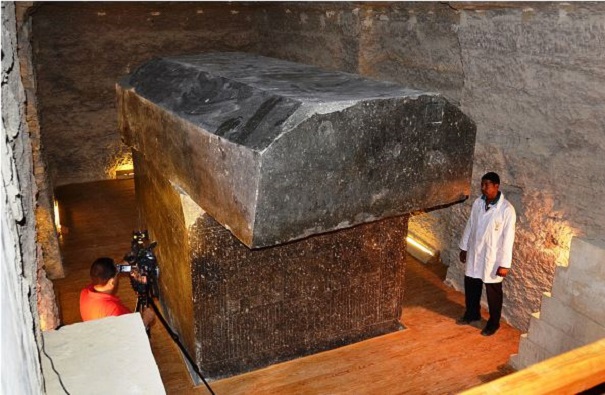
The Serapeum boxes are carved primarily from granite and diorite sourced from Aswan, roughly 800 kilometers south of Saqqara. Each box weighs between 70 and 100 tons, with lids alone exceeding 25–30 tons. The Serapeum logistics paradox begins before the boxes even reach Saqqara.
Transporting such masses over long distances requires:
-
Quarry extraction without fracturing
-
River transport with stable load distribution
-
Offloading at the Nile floodplain
-
Overland transport to the Saqqara plateau
-
Controlled descent into subterranean corridors
Each stage presents risks that scale exponentially with weight. Yet no ramps, sled tracks, anchor points, or loading platforms associated with the Serapeum have been conclusively identified.
Tunnel geometry and installation constraints
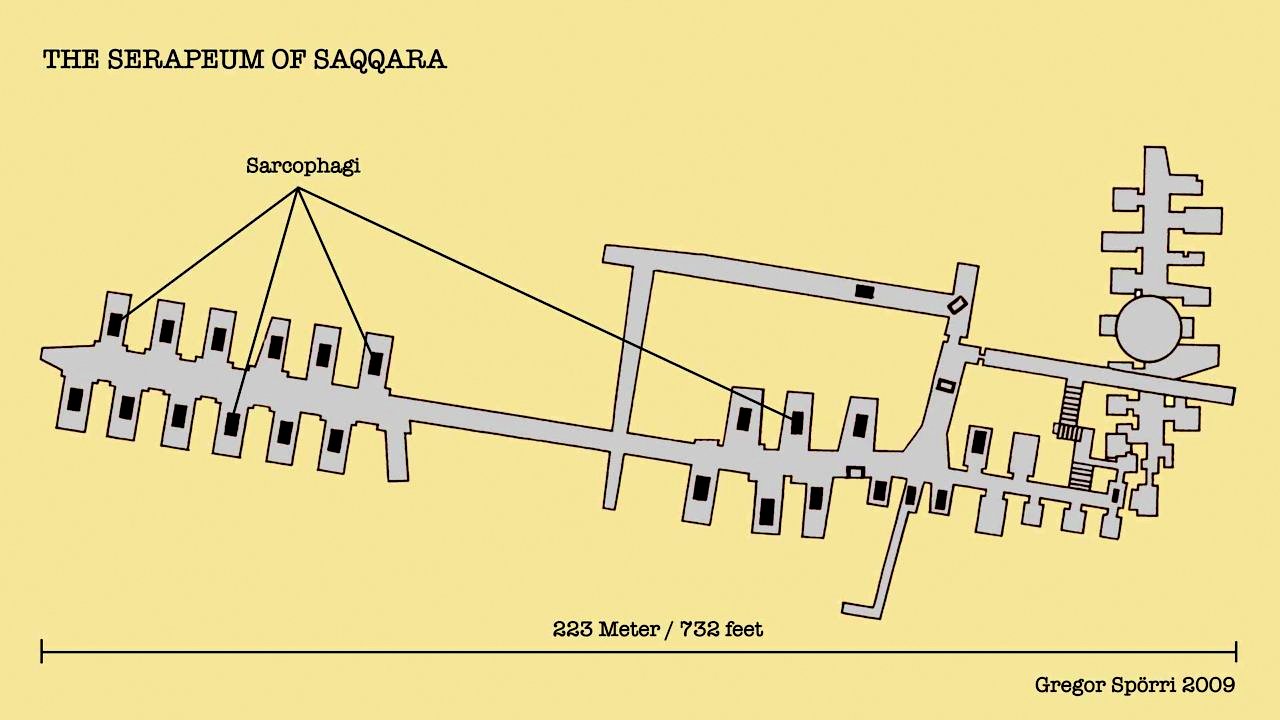
The underground galleries of the Serapeum are narrow, angular, and sharply limited in height. In several locations, clearance between box walls and tunnel walls is minimal. This creates a core problem in the Serapeum logistics paradox: the boxes appear too large to have been maneuvered easily within the finished tunnels.
Archaeological observations suggest that:
-
Some tunnels were enlarged after box placement
-
Boxes were positioned before final wall finishing
-
Turning radii are insufficient for simple dragging or rolling
If correct, this implies a construction sequence where tunnels and boxes were planned as a single integrated system, not as separate tasks. The boxes were not merely placed into finished chambers; the chambers were shaped around them.
Placement accuracy and force control
Another dimension of the Serapeum logistics paradox is placement precision. The boxes are not simply dropped into position; they are aligned, leveled, and seated with extraordinary accuracy. Lids fit flush with minimal gaps. Achieving this requires:
-
Controlled horizontal and vertical movement
-
Fine adjustment under extreme load
-
Stable support during placement
-
Measurement standards capable of repeatability
This level of control is difficult even with modern cranes and hydraulic systems in confined spaces. The paradox deepens when one considers that no clear evidence of scaffolding, lifting frames, or mechanical advantage systems remains in the tunnels.
Conventional explanations and their limits
Mainstream explanations propose sleds, rollers, levers, and human labor. While these methods are well-documented for surface transport, they struggle to account for the underground phase of the Serapeum logistics paradox.
Key limitations include:
-
Rollers require flat, open surfaces
-
Sleds require friction management and straight paths
-
Lever systems require space and anchor points
-
Human-powered hauling becomes impractical at extreme weights in confined spaces
None of these methods explain how boxes were rotated, aligned, and seated inside tunnels with minimal clearance. Nor do they explain the absence of damage to tunnel walls or box edges.
External reference: https://www.britishmuseum.org/collection/guides/ancient-egypt
Alternative logistical models
To address the Serapeum logistics paradox, several alternative models have been proposed, each controversial but grounded in engineering logic.
1. Incremental Excavation Around Pre-Positioned Boxes
Boxes may have been lowered into partially excavated shafts, with tunnels expanded afterward. This would reduce lateral movement but requires precise vertical lowering and planning.
2. Counterweight or Gravity-Assisted Systems
Inclined shafts and counterbalanced systems could allow controlled descent using gravity rather than brute force. No direct evidence survives, but erosion may have erased surface infrastructure.
3. Hydraulic Assistance
Some researchers suggest seasonal flooding or controlled water channels were used to float or reduce friction during transport. While speculative, water-based logistics are well documented in Egypt.
4. Lost Mechanical Techniques
The possibility remains that lifting or sliding technologies existed that are no longer archaeologically visible, either due to organic materials or later reuse.
None of these fully resolve the paradox, but each addresses constraints ignored by simple sled-based explanations.
Why the logistics matter
The Serapeum logistics paradox is not a side issue—it directly affects interpretation of function. If the boxes were extraordinarily difficult to install, their purpose must have justified the effort. This strengthens arguments made in earlier Ancient360 investigations:
When logistics exceed ritual necessity, function must be reconsidered. Engineering effort is a proxy for importance.
Global comparisons
Comparable logistical challenges appear worldwide:
-
Peru: multi-ton blocks at Ollantaytambo placed on steep terrain
-
Baalbek: trilithon stones exceeding 800 tons
-
Malta: underground megalithic chambers
-
Turkey: deep subterranean complexes
These parallels suggest that ancient societies may have possessed advanced logistical planning capabilities that modern archaeology has not fully reconstructed.
Internal reference: Forgotten Engineers #1 – Forgotten Engineers #2 (Ancient360)

Key questions moving forward
The Serapeum logistics paradox leads to several focused research questions:
-
What construction sequence best fits the tunnel geometry?
-
Are there micro-traces of anchoring, friction reduction, or guide systems?
-
Can 3D simulations model box movement realistically within tunnel constraints?
-
Were surface installations removed or repurposed in later periods?
-
Does the logistics burden imply a non-funerary, high-priority function?
These questions are testable with modern tools such as LiDAR, photogrammetry, and mechanical simulation.
Conclusion
The Serapeum logistics paradox exposes a gap between accepted explanations and physical reality. Moving, positioning, and sealing granite boxes of this size inside narrow underground galleries demands planning and control that go beyond traditional models. Until this paradox is resolved, interpretations of the Serapeum—funerary or otherwise—remain incomplete.
The next article in this series will explore whether these logistical demands imply centralized planning and a forgotten organizational structure behind the Serapeum’s construction.