The Serapeum Unfinished Box
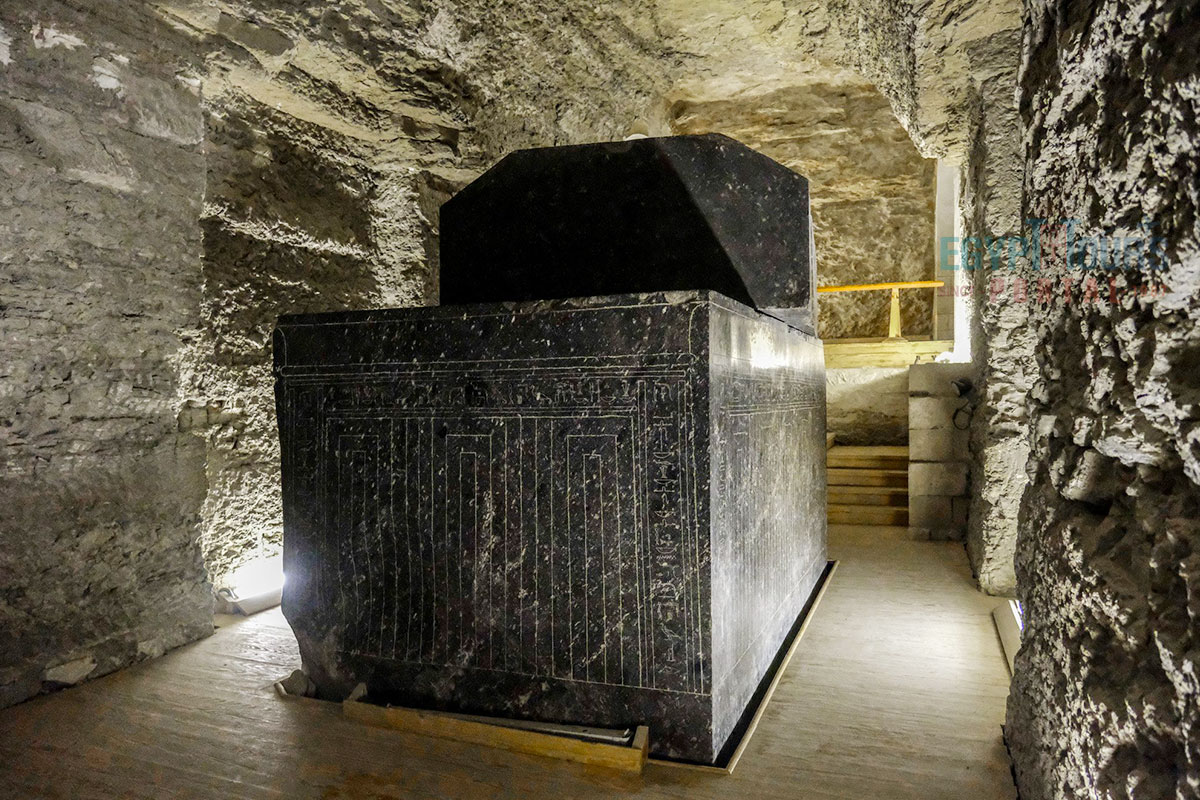
The Serapeum unfinished box is a critical anomaly in Egyptology and ancient engineering studies. Unlike the other fully completed granite boxes in Saqqara’s Serapeum, this unfinished monolith provides unique insight into the construction techniques, planning, and technical capabilities of its builders. Examining the Serapeum unfinished box allows researchers to explore how ancient engineers approached the transportation, shaping, and installation of multi-ton granite artifacts.
Mainstream interpretations consider all Serapeum boxes as sarcophagi for Apis bulls. Yet the unfinished box highlights engineering steps that are invisible in completed examples, revealing tool use, workflow, and potential design intentions—evidence that raises new questions about their actual function.
Observing the Unfinished Box
The Serapeum unfinished box differs from completed counterparts in several ways:
-
Roughly hewn exterior surfaces and partially polished interior
-
Visible tool marks along corners and edges
-
A partially fitted lid lying nearby
-
Dimensions and cavities consistent with finished boxes, suggesting it was intended to be identical in size
The unfinished state provides a rare glimpse of the construction sequence: rough carving, internal shaping, polishing, and lid fitting. This progression is otherwise hidden in finished boxes. Archaeologists can study the unfinished box to infer methods, tool types, and precision techniques.
Engineering Insights from the Unfinished Box
The Serapeum unfinished box demonstrates that the builders employed sophisticated engineering strategies:
-
Material Planning: Granite slabs were quarried in Aswan, then transported hundreds of kilometers to Saqqara. The unfinished box shows how rough shaping occurred after placement in tunnels, not entirely at the quarry, suggesting careful logistical planning.
-
Tool Evidence: Deep grooves and pecking marks indicate repeated abrasion using harder stone or abrasive sand. Micro-striations suggest techniques far more precise than simple chisel work.
-
Surface Preparation: The interior surfaces are partially smoothed, implying that fine polishing was the final step, perhaps after the box was positioned. This indicates a construction workflow consistent with industrial or proto-industrial methods.
-
Lid Fitting: The nearby partially finished lid illustrates precise measurement practices. Even unfinished, the lid’s shape matches the box’s internal tolerances, reinforcing the possibility of standardized production methods.
Rethinking the Function
The Serapeum unfinished box challenges conventional interpretations. If all boxes were purely funerary:
-
Why would the builders invest enormous time and energy in partial pre-polishing before placement?
-
Why was such a massive box left incomplete while others were finished?
-
Does the unfinished box represent a learning experiment, a quality-control prototype, or a specialized function distinct from burial?
Alternative hypotheses for the Serapeum unfinished box include:
-
Engineering Prototype: A test for tolerances, structural stability, or transport methods.
-
Experimental Storage: Perhaps intended for sensitive contents requiring controlled internal dimensions.
-
Acoustic or Resonant Testing: Partial finishing could indicate experimentation with vibrational properties.
-
Symbolic or Ritual Purposes: Even unfinished, the box could have had ceremonial significance, perhaps representing incomplete or transitional states.
Global Parallels
Worldwide, incomplete megalithic structures provide insight into construction methods:
-
Peru: Partially shaped stone monoliths at Ollantaytambo suggest stepwise finishing in situ.
-
Malta: Incomplete Hypogeum chambers reveal stages of carving and polishing.
-
India: Unfinished granite vaults in subterranean complexes provide evidence of sequential workflow.
The Serapeum unfinished box fits into this pattern, indicating that stepwise construction with a sequence of roughing, shaping, and finishing is a global ancient practice.
Key Questions for Investigation
Studying the Serapeum unfinished box allows researchers to ask targeted questions:
-
What sequence of tools and techniques were used to achieve the final tolerances?
-
Did the builders use measuring standards or templates for internal geometry?
-
Why was this box abandoned or left incomplete?
-
Can residue or micro-wear analysis detect its intended contents or environmental exposure?
-
How does the unfinished box inform the broader Serapeum box function question?
Answering these may reveal whether construction methods were standardized or experimental and whether the Serapeum boxes had a unified function or multiple operational purposes.
References and additional reading
-
The Serapeum Engineering Mystery link
-
Serapeum Precision Machining link
-
The Serapeum Box Function link
- Celestial Engineers Measuring the Heavens link
-
British Museum: Saqqara overview — link
-
IFAO Saqqara excavation reports — https://www.ifao.egnet.net
-
Petrie, W.M. Flinders — The Serapeum of Memphis link
-
Alchemists of Stones link
- The Geometries of Power link