The Precision Problem in Ancient Stonework
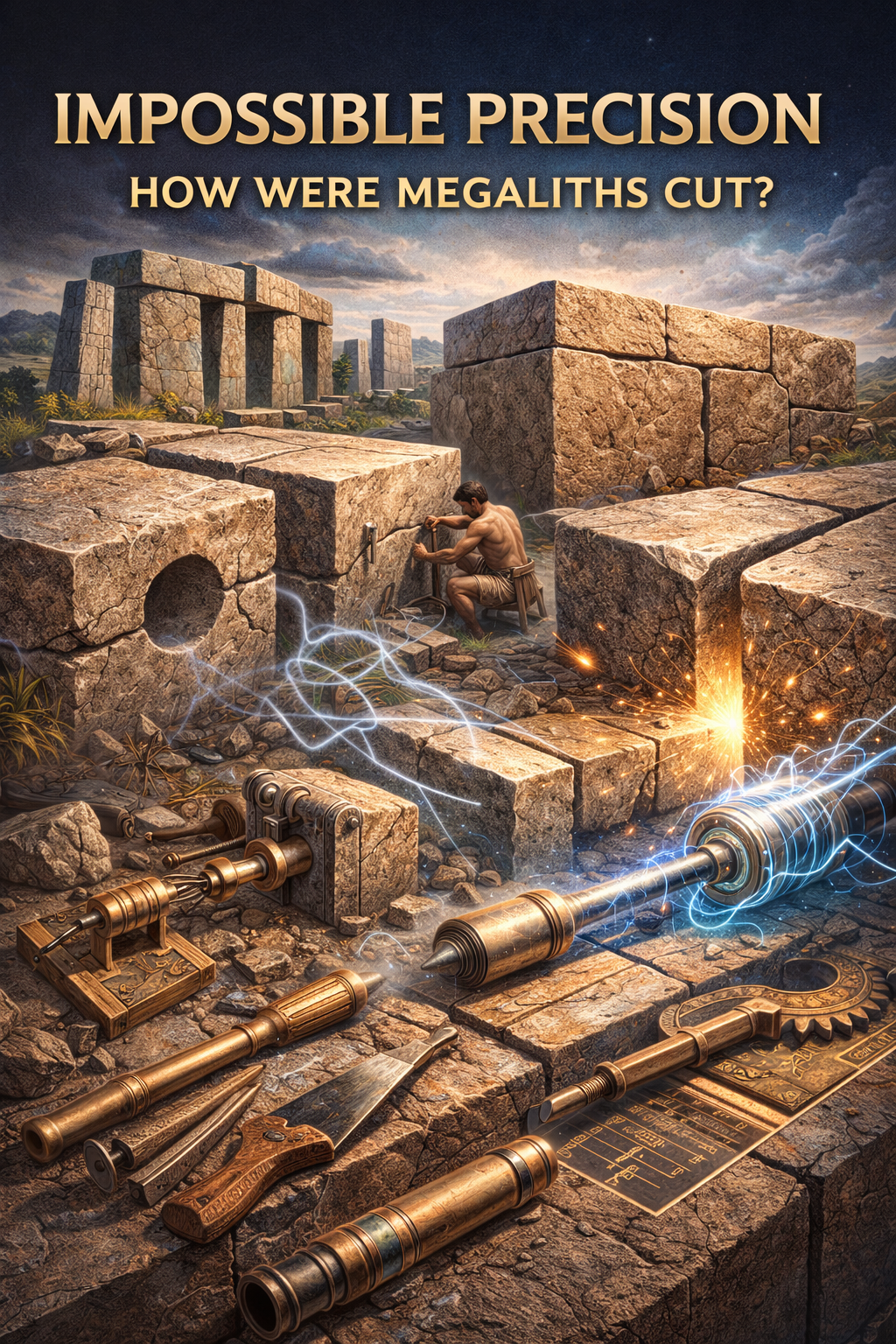
The question of megalith cutting precision stands at the center of one of the most persistent and technically challenging debates in archaeology and engineering. Across multiple ancient sites, stone blocks weighing several tons exhibit levels of flatness, symmetry, and joint accuracy that rival or, in some cases, appear to exceed what is achievable with conventional pre-industrial tools. These observations raise a fundamental question: how were such results obtained with the technologies traditionally attributed to these civilizations?
Mainstream archaeology provides explanations based on known tools and techniques, including copper chisels, stone hammers, abrasives such as sand, and prolonged manual labor. While these methods are capable of producing finely worked surfaces, the scale, consistency, and repetition of high-precision features in megalithic construction suggest that additional factors may have been involved. This does not necessarily imply the existence of advanced or lost technologies in the modern sense, but it does require a closer examination of the processes and systems that enabled such outcomes (Ancient Construction Systems Megalithic Engineering link).
The purpose of this article is to analyze the evidence related to megalith cutting precision, integrating archaeological findings, engineering principles, and experimental research to evaluate how ancient builders may have achieved such remarkable results (Ancient Construction Project Management link).
Defining Precision: Metrics and Observations
Before exploring possible techniques, it is essential to define what is meant by precision in the context of megalithic construction. Precision can be measured in several ways, including surface flatness, angular accuracy, alignment between adjacent blocks, and the uniformity of repetitive features such as drill holes or cut marks (Ancient Construction Systems: Myth or Reality link).
In sites such as the Giza Plateau, Machu Picchu, and various megalithic complexes, researchers have documented joints between stones that are so tight that a blade cannot be inserted between them. Surfaces appear smooth and level across large areas, and angles are maintained with a degree of consistency that suggests careful measurement and control.
From an engineering perspective, achieving this level of precision requires not only effective tools but also systems for measurement, verification, and correction. It implies the presence of workflows that allow for iterative refinement, ensuring that each element meets specific criteria before being integrated into the larger structure (Ancient Construction Engineering link).
Mainstream Explanations: Tools and Techniques
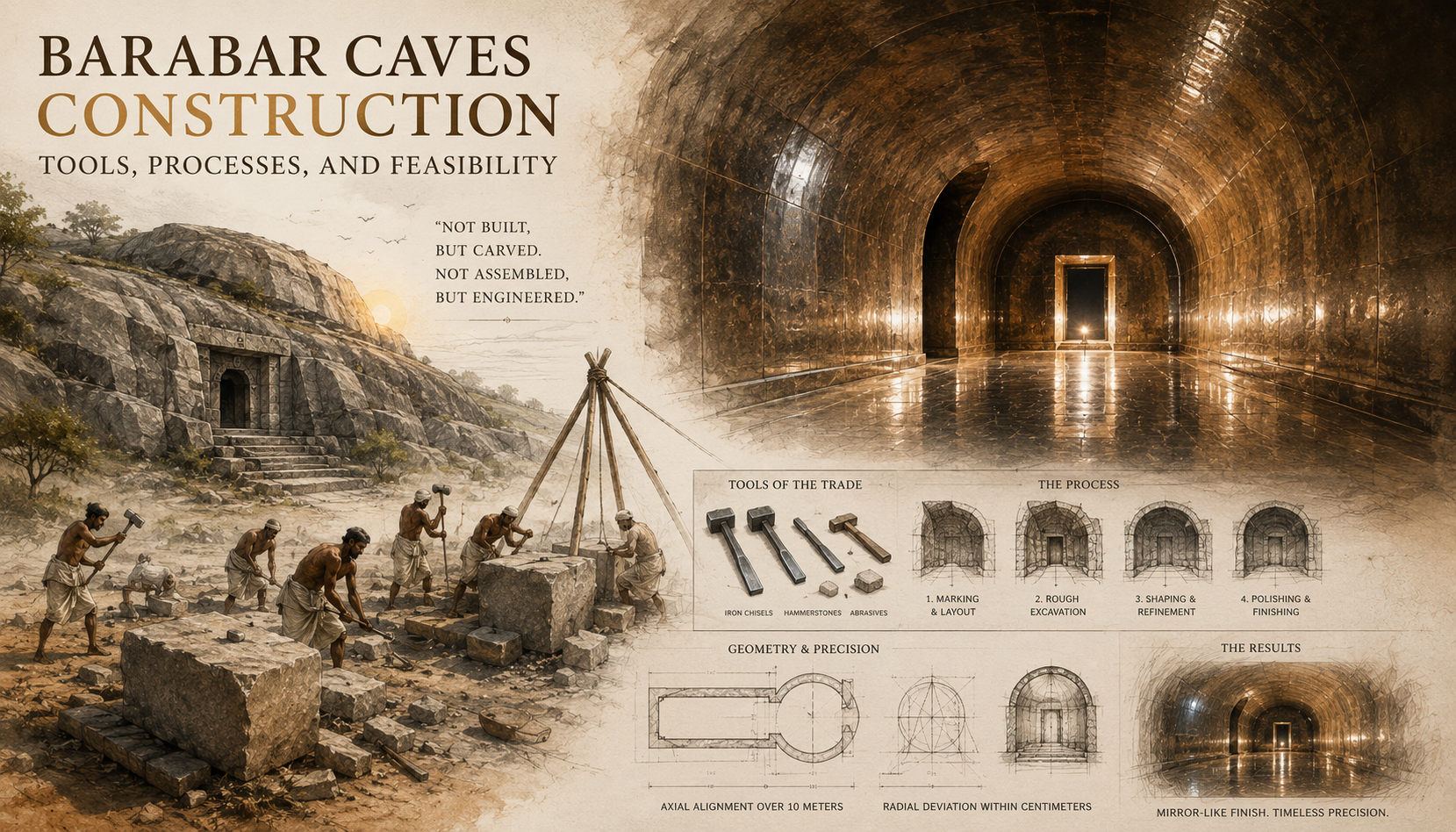
Traditional explanations for megalith cutting precision focus on the use of relatively simple tools combined with extensive labor and time. Copper chisels, for example, are known to have been used in ancient Egypt, often in conjunction with abrasive materials such as quartz sand to enhance cutting effectiveness. Stone hammers and pounding tools could shape rough blocks, which were then refined through grinding and polishing (Ancient Construction Systems Engineering link).
Experimental archaeology has demonstrated that these methods can produce smooth surfaces and accurate shapes, given sufficient time and effort. However, scaling these techniques to the level observed in large construction projects introduces challenges related to consistency and efficiency. Maintaining uniform precision across hundreds or thousands of blocks would require not only skilled العمال but also standardized procedures and quality control mechanisms.
While mainstream explanations remain plausible, they do not fully address all observed features, particularly those involving extremely tight tolerances and complex geometries.
Tool Marks and Surface Analysis
Detailed analysis of stone surfaces provides valuable insights into megalith cutting precision. In some cases, linear grooves, drill holes, and circular patterns have been identified, suggesting the use of tools capable of producing consistent and repeatable motions.
Certain drill holes, for example, exhibit characteristics such as uniform diameter and helical patterns that indicate rotational movement combined with downward pressure. These features can be replicated using modern tools, but reproducing them with ancient materials and methods remains a subject of ongoing experimentation.
The presence of such marks does not necessarily indicate advanced technology in the modern sense, but it does suggest that ancient builders developed effective techniques for controlling tool movement and material removal. Whether these techniques involved simple tools used in sophisticated ways or more complex उपकरण systems remains an open question.
The Role of Abrasives and Material Properties
Abrasive materials likely played a significant role in achieving megalith cutting precision, particularly when working with hard stones such as granite and basalt. Quartz sand, for example, is harder than copper and can be used to grind and shape stone surfaces when combined with consistent pressure and motion (Ancient Construction Materials – Lost Techniques link).
The effectiveness of abrasive techniques depends on several factors, including particle size, distribution, and the ability to maintain uniform contact between the tool and the stone surface. Achieving high precision through abrasion requires careful control of these variables, as well as the ability to measure and adjust the surface during the process.
Material properties also influence the outcome. Different stones respond differently to stress, vibration, and temperature, and understanding these responses would have been essential for achieving consistent results. This suggests that ancient builders possessed empirical knowledge of material behavior, even if it was not formalized in theoretical terms.
Independent Research: Expanding the Possibilities
Beyond mainstream explanations, independent researchers have proposed alternative interpretations of megalith cutting precision, exploring the possibility that ancient builders may have used techniques that are not fully represented in the archaeological record. These hypotheses include the use of advanced abrasives, lost tool designs, or methods that leverage natural forces such as vibration or resonance (Ancient Construction Geometry link).
Researchers associated with The Land of Chem have suggested that certain patterns observed in stonework could be consistent with controlled energy interactions, potentially involving resonance or other physical processes. While these ideas remain speculative, they highlight the importance of examining the full range of possibilities when confronted with unexplained features.
It is important to approach such hypotheses critically, distinguishing between testable claims and those that lack empirical support. At the same time, the existence of unresolved questions justifies continued exploration and experimentation.
Measurement Systems and Quality Control
Achieving megalith cutting precision on a large scale would require reliable systems for measurement and quality control. Ancient builders may have used tools such as plumb lines, straight edges, and leveling devices to ensure accuracy during the cutting and placement of stones.
Standardized units of measurement, whether based on body proportions or defined lengths, would have facilitated consistency across different stages of construction. The presence of repeated dimensions and proportional relationships in ancient structures suggests that such systems were in place.
Quality control processes would also have been necessary, allowing builders to identify and correct deviations before final assembly. This implies an organized workflow in which precision was not left to chance but was actively managed throughout the construction process.
Logistics and Repetition: Scaling Precision
One of the most challenging aspects of megalith cutting precision is the ability to replicate high-quality results across large numbers of components. This requires not only effective techniques but also efficient workflows and coordination among workers (Ancient Construction Logistics – Organizing the Impossible link).
The repetition of precise features across multiple stones suggests that ancient builders developed methods for standardizing processes, reducing variability, and ensuring consistency. This level of organization points to a sophisticated understanding of project management, even if it was not documented in written form.
The ability to scale precision also implies training and knowledge transfer, ensuring that skills were maintained and applied consistently across different teams and projects.
Modern Experiments and Limitations
Modern attempts to replicate megalith cutting precision provide valuable insights into the feasibility of different techniques. Experimental archaeology has demonstrated that many observed features can be reproduced using traditional tools and methods, but often with significant time and effort.
In some cases, modern experiments have struggled to match the exact characteristics observed in ancient stonework, particularly when it comes to achieving consistent precision across large surfaces. These limitations do not necessarily indicate the use of unknown technologies, but they do highlight gaps in our understanding of how ancient builders optimized their processes.
Continued experimentation, combined with advances in analytical tools, may help to bridge these gaps and provide a clearer picture of the techniques involved.
Conclusion: Precision as a System, Not a Mystery
The study of megalith cutting precision ultimately points to a conclusion that is both grounded and expansive: the remarkable quality of ancient stonework is best understood not as an isolated mystery, but as the result of integrated systems involving tools, materials, measurement, and organization. While some aspects remain unexplained, the evidence suggests that ancient builders developed highly effective methods for achieving precision, whether through known techniques used at scale or through processes that are not yet fully understood.
Rather than reducing the discussion to a binary choice between conventional explanations and speculative theories, a more productive approach is to continue investigating the full range of possibilities, guided by evidence and informed by interdisciplinary research. In doing so, the question of how megaliths were cut becomes not just a technical problem, but a window into the broader capabilities of early human societies (Ancient Construction Similarities and Global Parallels link).
References and Further Reading
Giza Power — Engineering analysis of the Great Pyramid (link)
The Land of Chem — Independent research on energy-based interpretations (link)
The Land of Chem — Independent analysis of ancient technologies
John A. Burke and Andrija Puharich — Seed of Knowledge, Stone of Plenty (link)
John A. Burke — Experimental research on megalithic sites
ResearchGate — Study on ancient irrigation and environmental systems
ResearchGate — Academic studies on ancient engineering and materials
Encyclopaedia Britannica — Ancient Engineering and Architecture
JSTOR — Archaeological and Engineering Studies
JSTOR — Archaeological Studies on Stoneworking Techniques (link)
Ancient Maps and Star Charts — Lost Knowledge Traditions (link)
Ancient Construction Materials — Lost Techniques (link)