Second Sphinx Beneath Giza? Hidden Discovery
Long before modern archaeology drew its timelines, evidence has quietly surfaced suggesting that human civilization may be far older—and far more advanced—than we’ve been taught. From enigmatic cartographic anomalies like the Zeno Map, the Gerardus Mercator Map, and —among many others— the Philippe Buache Map—depicting lands such as Antarctica centuries before official discovery—to growing research into ancient navigation technology that implies lost seafaring precision, the past begins to look far less primitive. When paired with sites like Göbekli Tepe, submerged structures in the Caribbean, vast Asian megalithic complexes, and indications of lost geometry knowledge, a compelling question emerges: are we only seeing the surviving fragments of a much older, more sophisticated human story?
A Signal Beneath the Sand
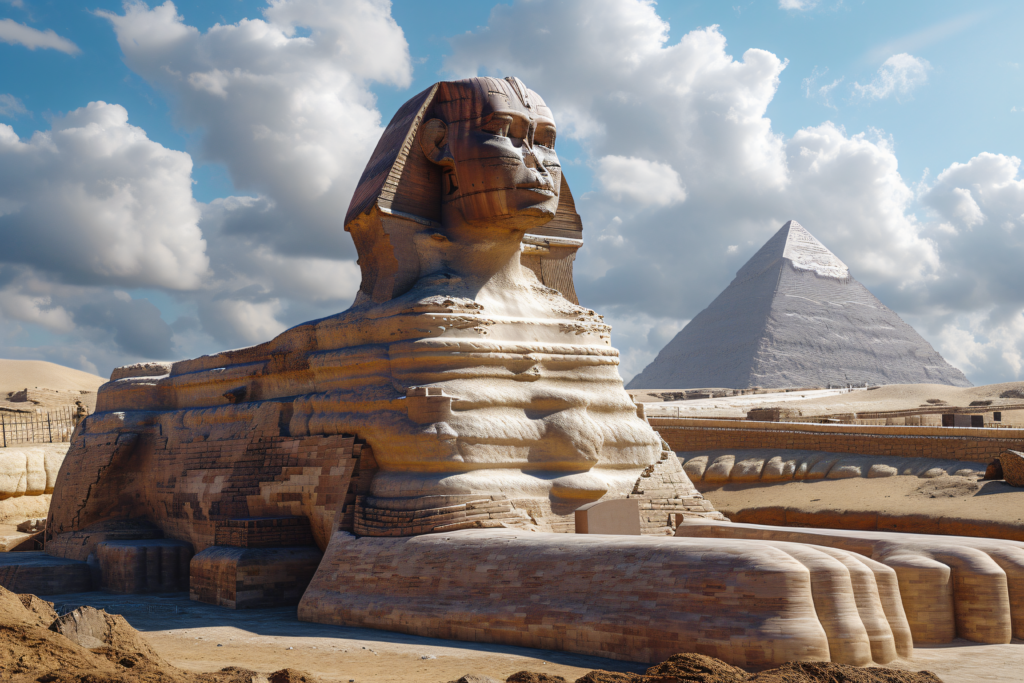
In 2026, Italian researcher Filippo Biondi and his team reignited global fascination with Giza. Using advanced remote sensing techniques, they identified what appears to be a large subsurface structure near the existing Sphinx—hidden beneath a mound of compacted sand. What makes this claim compelling is not just the size—estimated around 108 feet—but the symmetry.
- Vertical shafts and horizontal passages
- Geometric alignments with the pyramids
- Structural similarities to known features beneath the Sphinx
These patterns hint at intentional design, not random geology. According to Biondi, the correlations are so precise that he places his confidence at around 80% that something monumental lies below. Even more provocative is the suggestion of an “underground megastructure”—a network of chambers and tunnels extending beneath the plateau itself.
The Dream Stele: A Message from the Past?
Standing between the paws of the Great Sphinx is the Dream Stele, erected by Pharaoh Thutmose IV over 3,000 years ago. It has long been interpreted symbolically—but some now argue it may contain literal clues. The stele appears to depict two sphinxes, not one. Mainstream Egyptology dismisses this as artistic convention. But reconsider the possibility: What if ancient Egyptians were not illustrating myth—but recording memory?
If so, the stele could be less a symbolic artifact and more a fragment of historical truth, hinting at a dual-monument layout now partially lost to time.
Technology vs Tradition
Here is where the divide becomes clear.
Conventional experts argue:
- No excavation has confirmed a second Sphinx
- Radar methods cannot reliably detect structures at great depth
- Decades of study at Giza have revealed no such monument
And yet, this position raises its own questions. If earlier generations lacked the tools we now possess, how much of Giza remains unseen simply because it was undetectable?
Modern technologies—satellite radar, signal processing, and even experimental muon scanning—are beginning to reveal voids, chambers, and anomalies previously invisible.
History shows us a pattern: What was once dismissed as fringe often becomes accepted once the tools catch up.
Echoes of a More Advanced Past
Let us entertain a broader perspective. The Giza complex already defies easy explanation:
- Astronomical alignments of staggering precision
- Megalithic construction with unclear methods
- Subsurface features still being mapped today
If a second Sphinx—or a larger underground complex—exists, it may suggest that ancient builders possessed:
- Advanced geospatial planning
- Sophisticated knowledge of symmetry and energy flow
- Possibly even technologies or methods now lost
This does not require abandoning science—only expanding our assumptions. After all, even the debated water erosion hypothesis suggests the Sphinx may be far older than traditionally believed, pointing to climatic conditions and timelines that challenge orthodox narratives.
A Buried Truth Waiting?
So where does this leave us? We stand at a crossroads between:
- Skepticism grounded in established methodology
- Curiosity driven by new data and ancient anomalies
No excavation has yet confirmed a second Sphinx. That is true. But absence of evidence is not evidence of absence—especially in a landscape where vast portions remain unexcavated, restricted, or technologically unexplored. The more intriguing possibility is this:
The Giza Plateau may not be a completed story—but a partially buried one.
Final Thought
Whether the second Sphinx is real, symbolic, or something even more complex, the conversation itself reveals something deeper:
We may have underestimated the intelligence, capability, and intent of ancient civilizations.
And if even a fraction of these claims prove true, the sands of Egypt may not just hide monuments…
…but a forgotten chapter of human history waiting to be uncovered.
Additional Reading and Sources
New York Post: Second Sphinx Buried Under Sand (link)
GB News: Second Sphinx Emerges From Sand Egypt (link)
Heraldo USA: There Might Be Two Sphinxes Not Just One (link)
Great Pyramid Erosion Evidence It Is 20,000 Years Old (link)