The Serapeum precision machining mystery has become one of the most debated engineering puzzles in Egyptology. Beneath the sands of Saqqara lies a subterranean complex whose granite boxes exhibit machining attributes that appear far more advanced than the period traditionally assigned to them. In this second article of our Serapeum series, following Article #1’s analysis of the site’s engineering enigma, we now turn our focus to the physical evidence that suggests the presence of high-precision stone-working technologies. As with earlier Ancient360 investigations like Cart Ruts: Global Mystery and Functions and Behavior, the Serapeum once again challenges conventional narratives.
Geological and Architectural Context Behind Serapeum Precision Machining
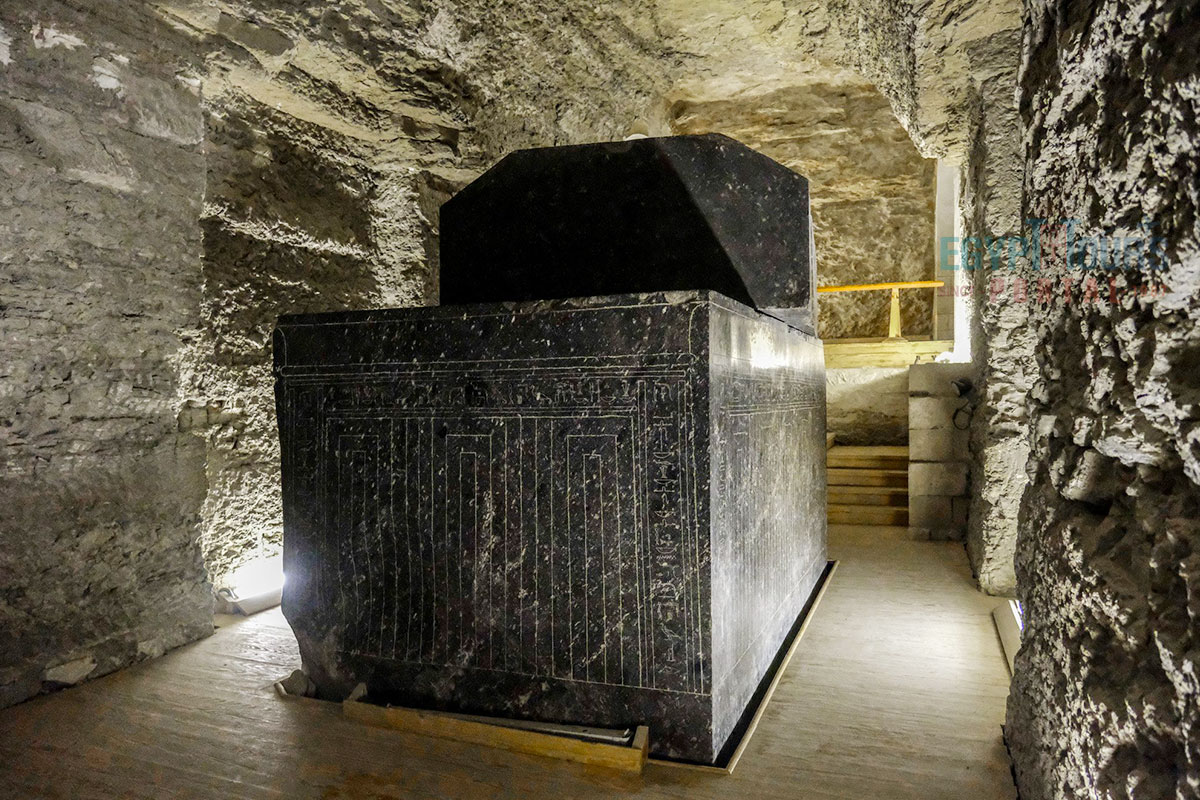
The Serapeum sits at coordinates 29°52′16″N, 31°12′58″E, carved deep into the limestone plateau of Saqqara. This geological setting is stable but unforgiving, making the installation of 70-100 ton granite boxes even more perplexing. The granite originates from Aswan—over 800 km away—and is among the hardest stones used in the ancient world.
What amplifies the Serapeum precision machining debate is the contrast between the rough, chisel-marked limestone tunnels and the hyper-smooth, high-tolerance interiors of the granite boxes. The abrupt shift from conventional Bronze Age craftsmanship to what appears like machine-level finishing is striking. Similar contradictions are noted in other global anomaly sites explored in Azores Underwater Ruts, where visible differences in tool typology suggest multiple phases of technological capability.
The Physical Evidence of Serapeum Precision Machining
The granite boxes exhibit several engineering traits that drive the controversy:
1. Mirror-Like Interior Surfaces
The internal faces of several boxes reflect light in a manner reminiscent of machined surfaces. The finish appears continuous and uniform, lacking the unevenness expected from handheld abrasion.
2. Sharp, Consistent Internal Angles
Internal corners appear extremely tight—some approaching what modern engineers describe as “near-machine-perfect.”
Copper tools, the conventional explanation, cannot achieve such internal geometries.
3. Dimensional Precision
Independent measurements (including those by the Digital Saqqara Project) show tolerances under 0.5 mm across long interior surfaces.
In modern terms, this is closer to industrial machining than stone carving.
4. Parallelism Across Large Surfaces
The parallelism of opposing interior walls is anomalously consistent. Achieving this manually on granite surfaces of several meters is a non-trivial feat even today.
5. Evidence of Controlled Abrasion
Microscopic analysis reveals striations consistent with directional, uniform abrasion—an attribute difficult to replicate with copper chisels or dolerite pounding stones.
Taken together, these features define the core of the Serapeum precision machining controversy: the level of accuracy appears inconsistent with known ancient Egyptian toolkits.
Mainstream Explanations vs. the Precision Puzzle
Mainstream View
Archaeologists typically describe the boxes as ceremonial sarcophagi made using standard Bronze Age methods: pounding, chiseling, polishing with sand-based abrasive, and repetitive smoothing.
Yet multiple contradictions remain:
-
The boxes display flat planes, not convex or irregular surfaces.
-
The internal angles are too sharp for pounding stones or copper chisels.
-
Polishing alone cannot account for dimensional tolerances under 1 mm.
-
Several lids appear to have been cut with a uniform downward feed rate.
These issues echo similar contradictions discussed in Farmers Scratching a Living?, where conventional agricultural or ceremonial explanations fail to explain physical engineering traits.

Alternative Hypotheses for Serapeum Precision Machining
1. Advanced Abrasive Technologies
Some researchers propose that ancient artisans may have used quartz-rich slurries combined with guided mechanical movement.
This could produce uniform abrasion but requires stable, repeatable control systems.
2. Rotational or Linear Mechanical Tools
A minority of engineers suggest the evidence resembles the output of:
-
Large rotary cutters
-
Bow-driven saws with abrasive slurry
-
Linear reciprocating saws
-
High-tension wire saws
These technologies, while speculative, would produce striations and precision similar to what is observed.
3. Lost or Forgotten Engineering Traditions
The Serapeum may represent the remnant of a technological era predating dynastic Egypt.
Its characteristics—precision, scale, and uniformity—mirror anomalies at other global sites in Worldwide: A Common Culture.
4. Multi-Phase Construction
Toolmark typology suggests that the boxes might not have been carved in the same era as the tunnels.
Some surfaces show machining-like marks, while others show conventional chisel use, implying different phases of technological capability.
5. Resonance or Acoustic Purpose
High precision might not have been decorative—it may have been functional.
Acoustic researchers have noted that tight tolerances affect sound resonance, raising the possibility that the boxes once served as resonant chambers or frequency devices.
Global Context: Is Serapeum Precision Machining Part of a Larger Pattern?
Comparisons with other megalithic sites reveal recurring traits:
-
The polygonal blocks of Peru
-
The precision stone boxes of Japan’s megalithic chambers
-
The unfinished obelisk at Aswan
-
The basalt pillars at Gobekli Tepe
-
The cut granite in South Indian temples
Two questions emerge:
-
Why do ancient cultures across continents share patterns of precision stonework?
-
Did they rely on similar, now-lost engineering principles?
The Serapeum precision machining evidence fits squarely into this global pattern, suggesting either parallel technological development or shared knowledge.
Recent Research and Technical Analysis
Cut mark microscopy, laser scanning, and digital modeling reveal:
-
Repetitive striation patterns indicating controlled mechanical movement
-
Edges that appear too sharp for non-metallic chisels
-
Abrasion marks consistent with quartz-based slurries under controlled pressure
-
Tooling consistency unachievable by isolated craftspeople without templates or jigs
Drone-assisted photogrammetry has also revealed potential layout geometry linking the Serapeum to broader Saqqara alignments.
Such precision hints at intentional design rather than mere ritual formality.
Key Questions for Ongoing Investigation
-
What tools or systems could maintain sub-millimeter tolerances on multi-ton granite surfaces?
-
Why were these boxes finished to such an extreme degree of precision?
-
Does the machining evidence imply industrial-level planning?
-
Is this technological capability consistent with the dynastic timeline?
-
What can modern engineers replicate—and what remains unexplained?
Conclusion
The Serapeum precision machining enigma is not a fringe speculation—it is a material fact observable on every granite box within the complex. Its engineering contradictions demand rigorous reassessment of ancient capabilities, toolkits, and historical timelines. This article deepens the Serapeum debate, setting the stage for Article #3, which will examine the true function of these enigmatic granite boxes.
Sources & Further Reading
-
Seraoeum Engneering Dilemma – link
-
Alchemist of Stones – Transmutation Technologies – link
-
Forgotten Engineers Builders Beyond Time – link
-
Harmonic of Stones. Resonance, Energy and Human Body – link
-
The Geometries of Power. Energy Grids and Sacred Design – link
-
Sacred Geometry in Ancient Architecture – link