Serapeum energy and resonance
The Serapeum energy and resonance hypothesis has gained increasing attention as engineers, physicists, and independent researchers confront a fundamental problem: the classical burial narrative fails to explain the physical reality of the site. The massive granite boxes beneath Saqqara exhibit characteristics that align more closely with engineered systems than funerary architecture. When evaluated through the lens of acoustics, vibration, and material science, the Serapeum begins to resemble a controlled environment designed for interaction with energy, sound, or resonance—not interment.
This article examines why the Serapeum energy and resonance model is increasingly persuasive when compared to the traditional explanation, and why professionals trained in mechanics, engineering, and physics find the burial hypothesis inadequate.
The burial narrative problem
The orthodox explanation holds that the granite boxes housed the remains of sacred Apis bulls. However, this interpretation struggles against multiple layers of hard data.
The boxes weigh between 60 and 80 tons, are sealed with equally massive lids, and are installed in narrow underground galleries with no evidence of repeated opening. No inscriptions clearly describing burial rituals exist on the boxes themselves. Many were found empty, disturbed, or lacking remains entirely.
From an engineering standpoint, the Serapeum energy and resonance question emerges immediately: why invest extreme precision, interior flatness, and acoustic-friendly geometry for a purpose that does not require it?
Burial does not demand micron-level flatness. Resonance does!

Granite as an energetic material
Granite is not an arbitrary choice. It is a composite stone containing quartz, a mineral with well-documented piezoelectric properties. Under pressure or vibration, quartz generates measurable electrical charge. Engineers and physicists recognize this immediately.
In the context of Serapeum energy and resonance, granite becomes a functional material, not symbolic stone.
The boxes display:
-
Thick walls capable of sustaining vibration
-
High mass for frequency stabilization
-
Smooth interior surfaces reducing energy loss
-
Rectangular geometry suitable for standing waves
These are properties associated with resonant chambers, not coffins.
Acoustic properties of the galleries
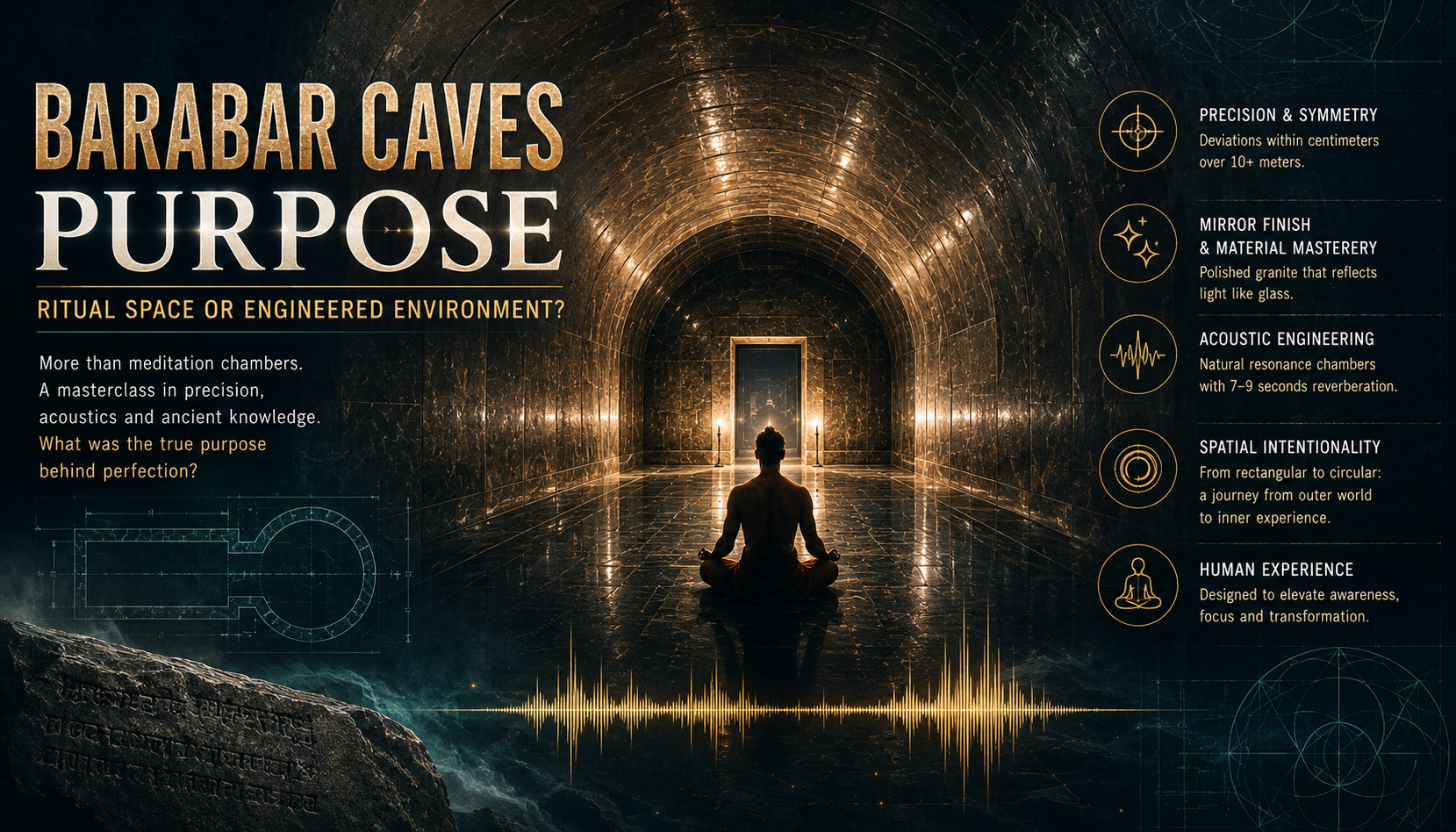
Independent acoustic testing conducted in the Serapeum corridors has revealed prolonged reverberation times and frequency amplification within specific ranges. Sound behaves unusually inside the chambers, especially when low-frequency tones are introduced.
From a Serapeum energy and resonance perspective, the underground location is critical. Subterranean spaces isolate vibration, reduce interference, and stabilize temperature—conditions favorable for acoustic experiments or energetic processes.
The narrow corridors act as waveguides. The boxes act as resonant masses. Together, they form a system.

Engineers vs tradition
One of the most striking aspects of the Serapeum energy and resonance debate is who finds the burial explanation unconvincing.
It is not primarily historians raising objections—it is:
-
Mechanical engineers
-
Structural engineers
-
Physicists
-
Machinists
-
Acousticians
-
Materials scientists
-
Engineering students replicating tests
These individuals approach the site without ideological attachment. They evaluate function based on form.
Their conclusions tend to converge: the design exceeds funerary requirements and aligns more closely with engineered containment or modulation of energy.

Researchers and proponents of the resonance hypothesis
The following researchers, authors, and independent investigators have contributed significantly to the Serapeum energy and resonance discussion. While their conclusions vary, they agree on one point: burial alone is insufficient.
-
Christopher Dunn — Mechanical engineer
-
The Giza Power Plant – link
-
Argues for ancient use of resonance and harmonic energy
-
-
Robert Schoch — Geologist
-
Emphasizes material choice and erosion context – link
-
-
Jay Weidner — Independent researcher
-
Explores alchemical and vibrational symbolism – link
-
-
John Reid — Engineer
-
Acoustic testing and wave behavior in stone chambers – link
-
-
Brien Foerster — Independent field researcher
-
Documentation of precision stonework worldwide – link
-
-
UnchartedX (Ben van Kerkwyk) — Mechanical analysis
-
Toolmark and machining comparisons – link
-
-
Students and machinists recreating granite cuts
-
Demonstrate implausibility of copper-only tooling – link
-
These voices are often dismissed not because their data is weak, but because it challenges entrenched narratives.

Hard data vs interpretive storytelling
The Serapeum energy and resonance hypothesis relies on measurable variables:
-
Geometry
-
Material properties
-
Mass
-
Frequency behavior
-
Toolmarks
-
Tolerances
The burial narrative relies heavily on analogy and assumption.
When engineers examine the boxes, they ask:
-
Why are the interiors more precise than the exteriors?
-
Why seal the boxes permanently?
-
Why isolate them underground?
-
Why use granite instead of limestone?
These questions are not answered by tradition.
Function beyond burial
If not burial, then what?
The Serapeum energy and resonance model does not claim certainty—but it proposes functional possibilities grounded in physics:
-
Resonant containment
-
Acoustic amplification
-
Harmonic experimentation
-
Material transformation
-
Energy stabilization or storage
-
Ritualized sound interaction
None of these require speculative mysticism. All require controlled environments and precision stonework.
Importantly, these functions explain features burial cannot.
Why the narrative resists change
The resistance to Serapeum energy and resonance theories is institutional, not evidential. Archaeology has historically prioritized symbolic interpretation over mechanical analysis. Engineers are rarely embedded in excavation teams.
As a result, structures are interpreted as ritual first, functional second—if at all.
This methodological bias creates blind spots.
Conclusion
The Serapeum energy and resonance hypothesis persists because it accounts for the physical evidence more coherently than the burial explanation. When granite choice, precision machining, underground acoustics, and system-level design are evaluated together, the Serapeum appears less like a tomb and more like a technological installation.
This does not diminish ancient Egypt. It elevates it.
If the boxes were engineered for function rather than burial, then the Serapeum represents a lost chapter in human technological experimentation—one that modern engineers are only beginning to recognize.
The next article in this series will explore whether this energetic knowledge connects to other global sites exhibiting similar resonant properties.